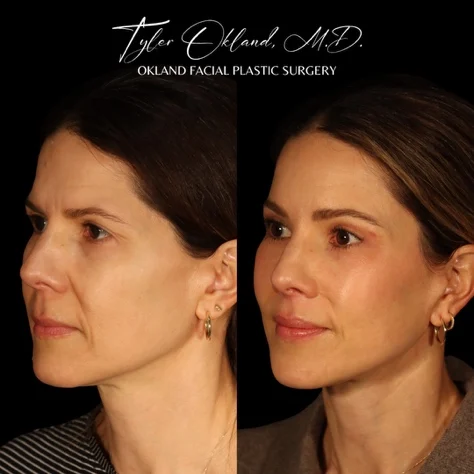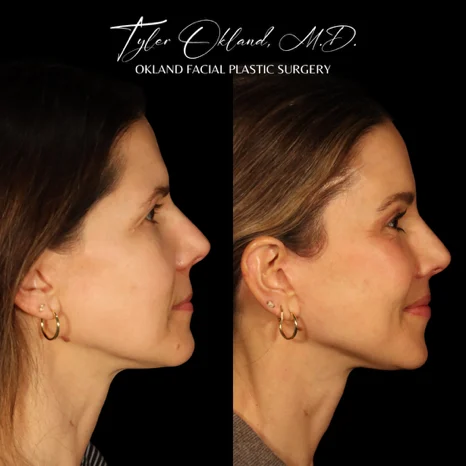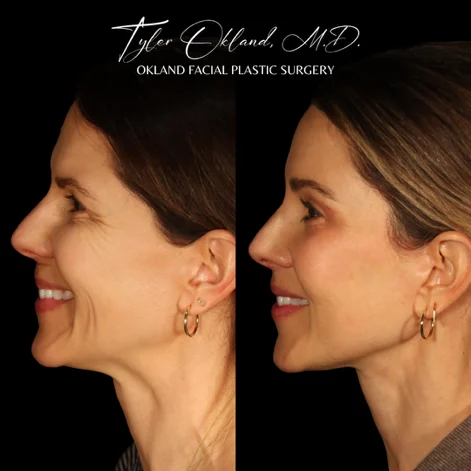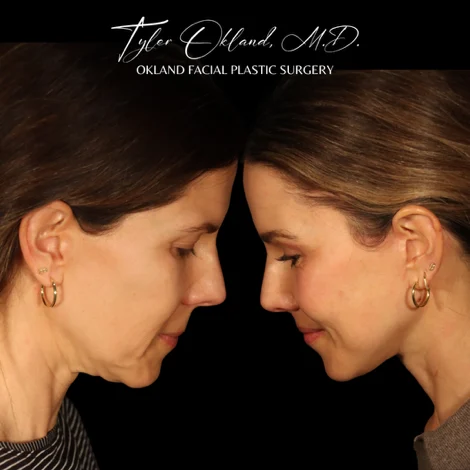

Prepare
Before surgery, Tone evaluates skin health and may recommend individualized medical-grade skincare, facials, microneedling or laser resurfacing to improve the surface upon which I will operate.
FACIAL REJUVENATION BY TYLER OKLAND, MD
Your face—restored, with a neck worthy of it.
Facelift surgery has entered an era in which the most powerful result can also be the least detectable. My objective is not to create a younger-looking stranger. It is to restore the face you recognize—the one you grew up with—while creating a jawline and neck that may be even more refined than the ones you remember.
I am a Stanford- and Vanderbilt-trained, double board-certified facial plastic surgeon. My practice is devoted exclusively to the face and neck. I perform extended deep plane face and neck lifting—not mini facelifts or traditional SMAS lifts—because this is the operation I trust to produce the most complete, natural and enduring results.
Every facelift I perform includes individualized full-face fat transfer. Every facelift patient is also integrated into Tone Medical Aesthetics to prepare the skin, support recovery and maintain the result over time.
The transformation should be unmistakable. The surgery should be undetectable.

Written and medically reviewed by Tyler Okland, MD. Last updated August 2026.
The Definition
An extended deep plane facelift is a face-and-neck lift performed beneath the SMAS and platysma through an extended surgical field that releases the retaining structures tethering the cheek, jowl, jawline and neck. Instead of asking skin tension to manufacture the result, the deeper facial tissues are mobilized and repositioned as a connected unit so the skin can redrape naturally over them.
The words “deep plane” alone do not tell you how far the surgery extends, which retaining ligaments are released, or how the neck is treated. “Extended” matters because the operation continues farther through the face and into the neck. In my practice, the face and neck are one operation, and individualized fat transfer addresses the volume loss that lifting alone cannot replace.
| At a glance | Dr. Okland’s practice |
|---|---|
| Operation | Extended deep plane face and neck lift |
| Volume restoration | Individualized full-face fat transfer included |
| Typical social recovery | Approximately 2–3 weeks |
| Surgical maturity | Approximately 6–12 months |
| Long-term evidence | Revision patients in a 2026 30-year series returned after an average of 10.9 years |
| Anesthesia | General anesthesia in an accredited operating room with a board certified anesthesiologist only. |
Dr. Okland performs only extended deep plane facelift surgery with modern preservation modifications, which is the most advanced facial rejuvenation technique in the world.
Facelift surgery has never been better. The words “deep plane” have never meant less.
For years, the public learned to recognize the visual language of a facelift: a face pulled toward the ears, flattened cheeks, joker smile, a pixie ear. Those results created the enduring fear that surgery might make someone look tighter, but no longer quite like herself.
Modern anatomical facelifting begins from a different premise. Aging is not simply loose skin. It is a structural process involving tissue descent, changes in facial volume, persistent ligament boundaries, the relationship between the face and neck, and deterioration of the skin itself. We are now in the era of undetectable facial rejuvenation surgery.
An exceptional result should look biographically accurate—as though the patient has returned to an earlier chapter of her own life rather than been recast as someone else. Identity remains intact; age fades. My shorthand is simple: you should look the way you used to, but with an upgraded jawline and neck.
The brow, eyes, cheeks, jawline and neck do not age independently. Returning the lower face to one decade while leaving the upper face in another may be a technical improvement but visually incongruous. The more powerful the facelift, the more obvious that discrepancy becomes.
This is why I do not perform a facelift without a comprehensive deep neck lift and why, for most true facelift candidates, my baseline facial rejuvenation operation also includes a brow lift and individualized fat transfer. Additional procedures—blepharoplasty, lip lift, resurfacing—are selected only when they earn a place in the composition.
Patients can now watch operations, follow recoveries, study scars and compare dozens of results before entering consultation. That transparency is valuable. It has also made surgical terminology easier to manipulate.
“Deep plane” is now used to describe operations that differ enormously in depth, release and power. It is not a certification, a style or a synonym for advanced. It describes where the surgeon operates, how far the dissection travels and which retaining structures are released. Phrases such as “mini deep plane” or “SMAS deep plane” should be met with healthy suspicion. Mixed or confusing terminology is a red flag because it blends distinct anatomical ideas without defining the operation.
When terminology becomes complicated, return to the anatomy. Anatomy is much harder to manipulate than language.
Releasing tissue creates movement; it does not decide where the tissue should go. A technically legitimate deep plane dissection performed along the wrong vectors can still look tight, distorted or unfamiliar.
Proper vectors restore height to the cheek without changing the mouth, recover the jawline without flattening the midface and create continuity between the face and neck. Experience matters, but years in practice do not automatically create aesthetic judgment. Experience teaches a surgeon what can be done. Surgical instinct, three-dimensional judgment and an artistic eye determine what should be done.
Evaluate a surgeon’s results across many patients, facial structures and treatment plans. There should be a pattern: recognizable patients, harmonious facial regions, quiet scars and comprehensive rejuvenation you repeatedly find beautiful. No two results should be identical. The quality of the judgment should be.
A great facelift result should withstand more than a flattering frontal photograph. Study the eyes, cheek, jawline and neck together. Look at the three-quarter and profile views. Look at the ear. Look at the scar. Look for a patient who remains immediately recognizable, with rejuvenation that is powerful enough to notice and quiet enough that you cannot see where the surgery begins.
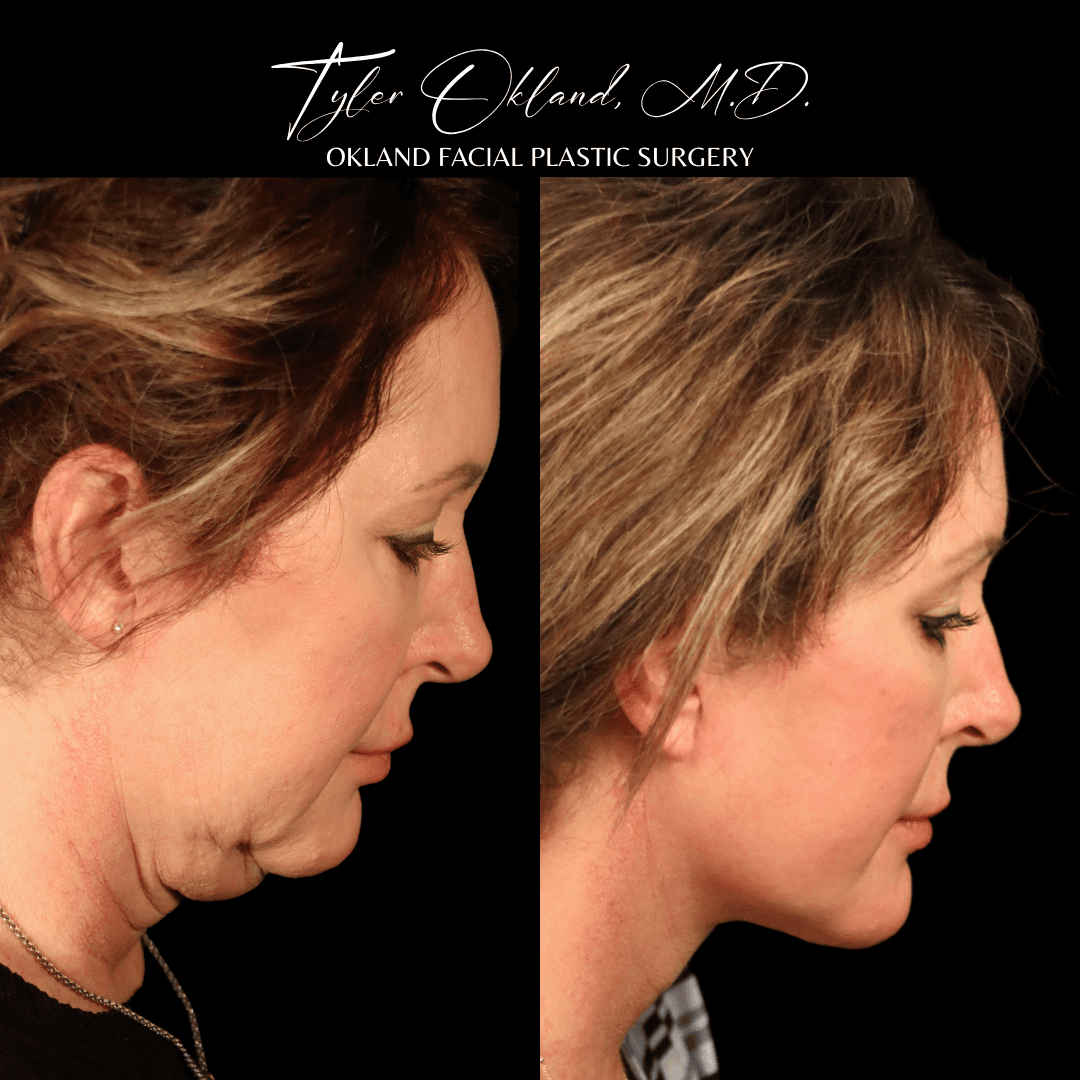
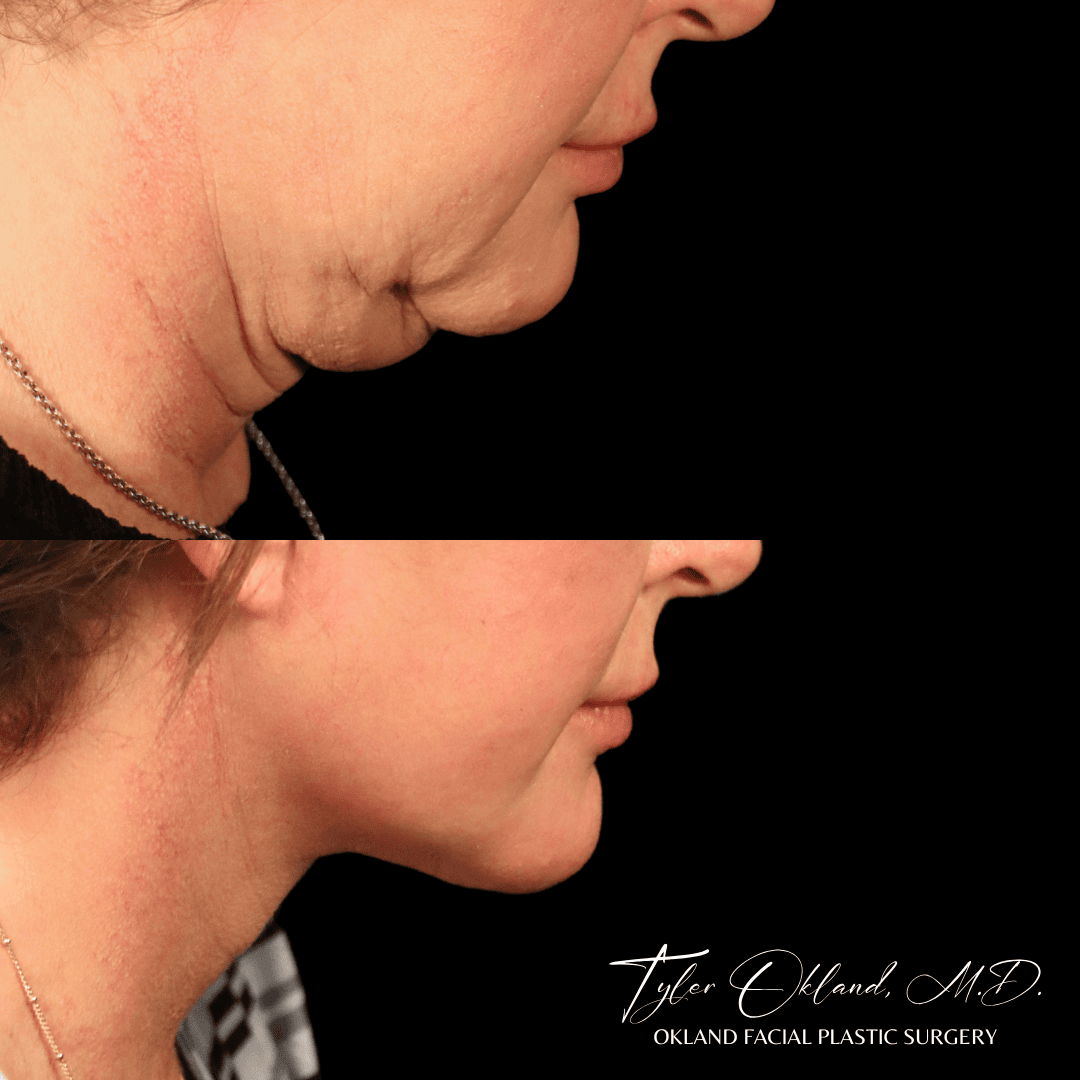
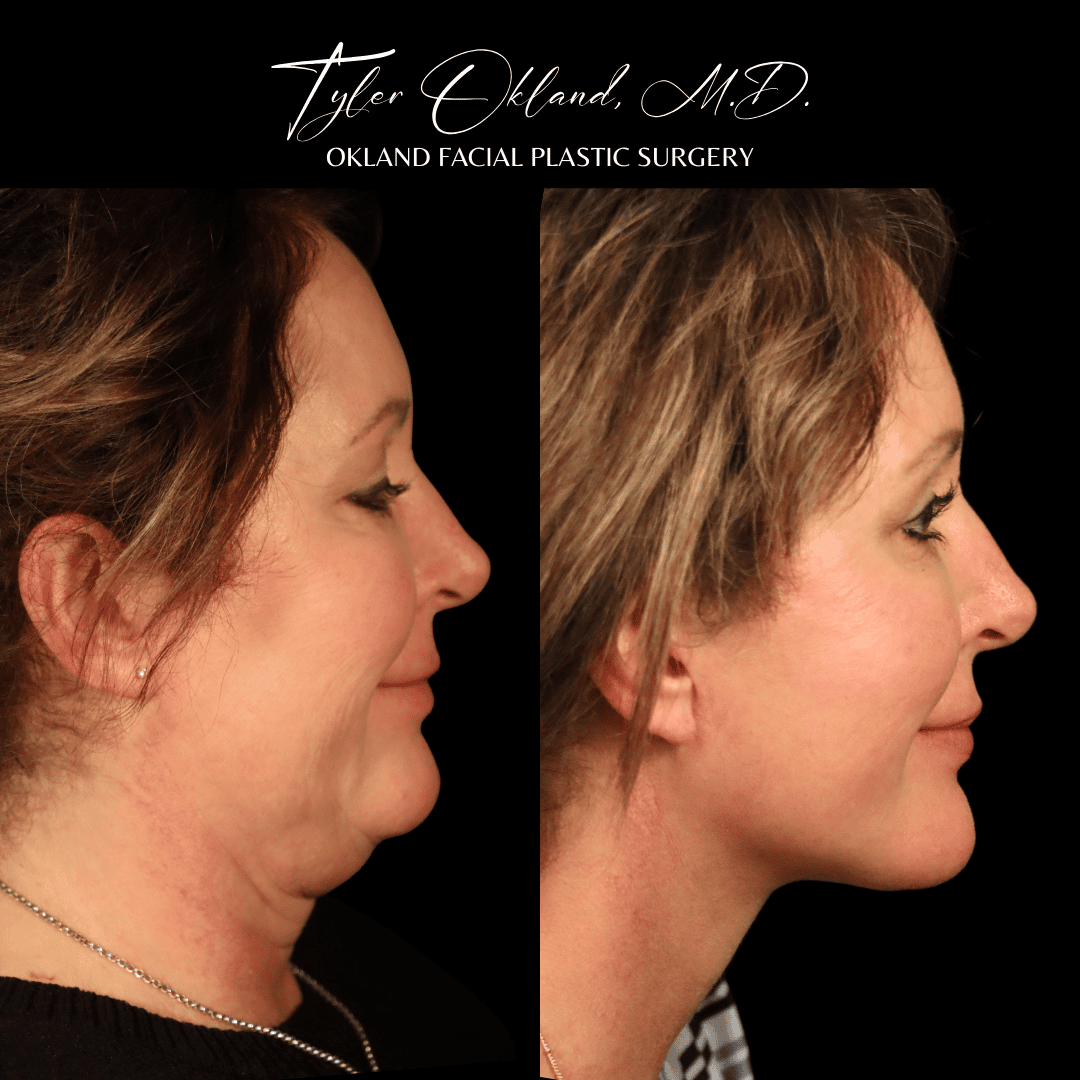
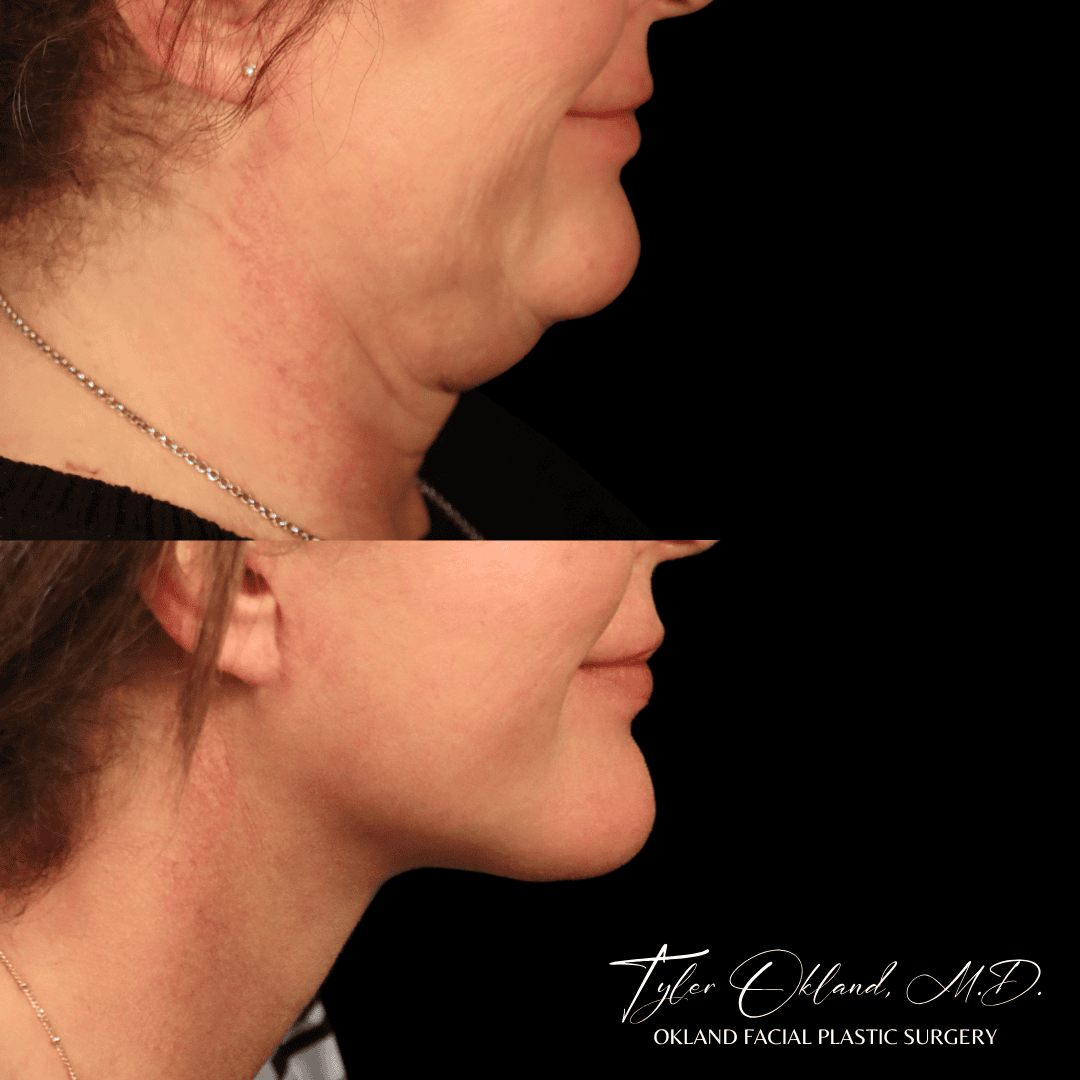
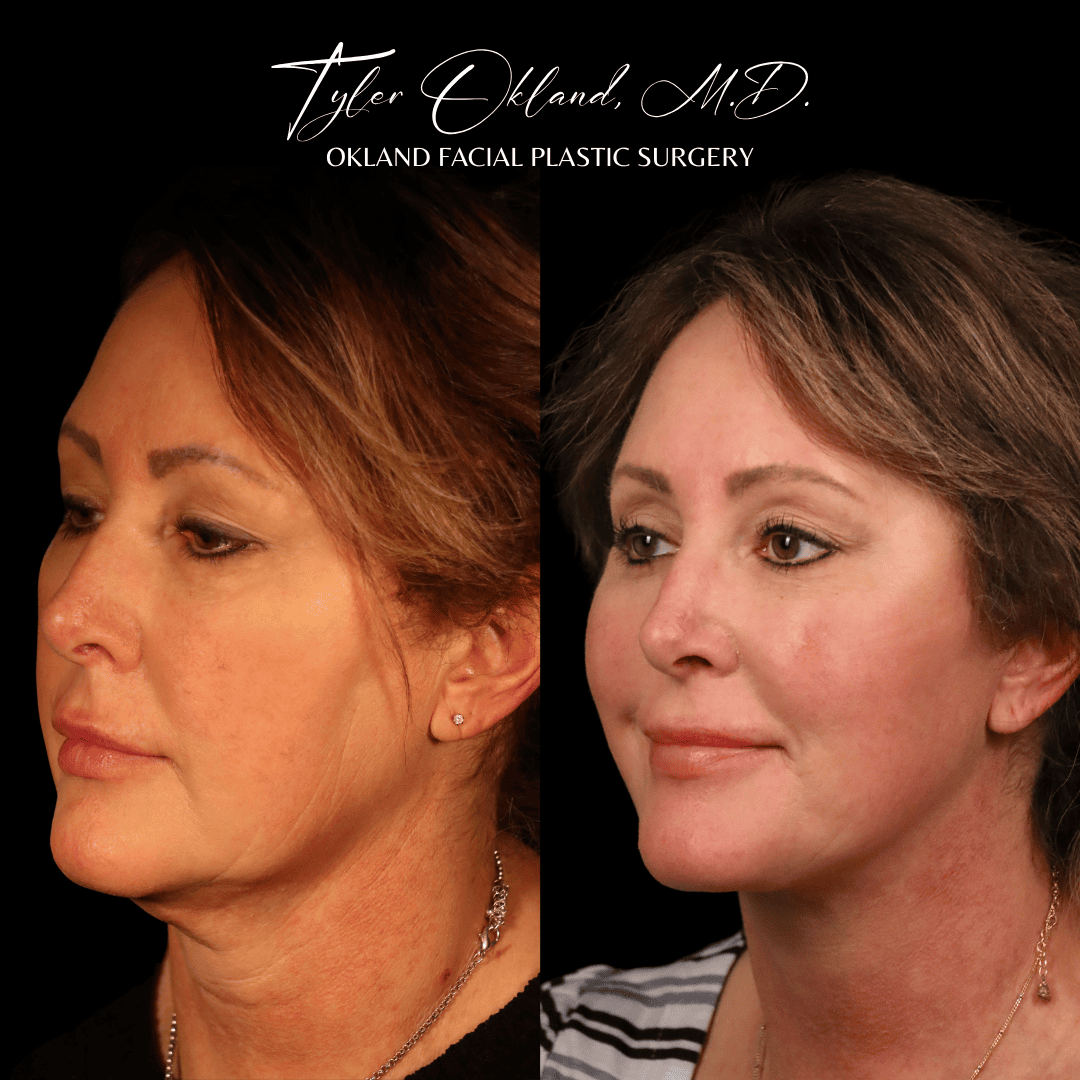
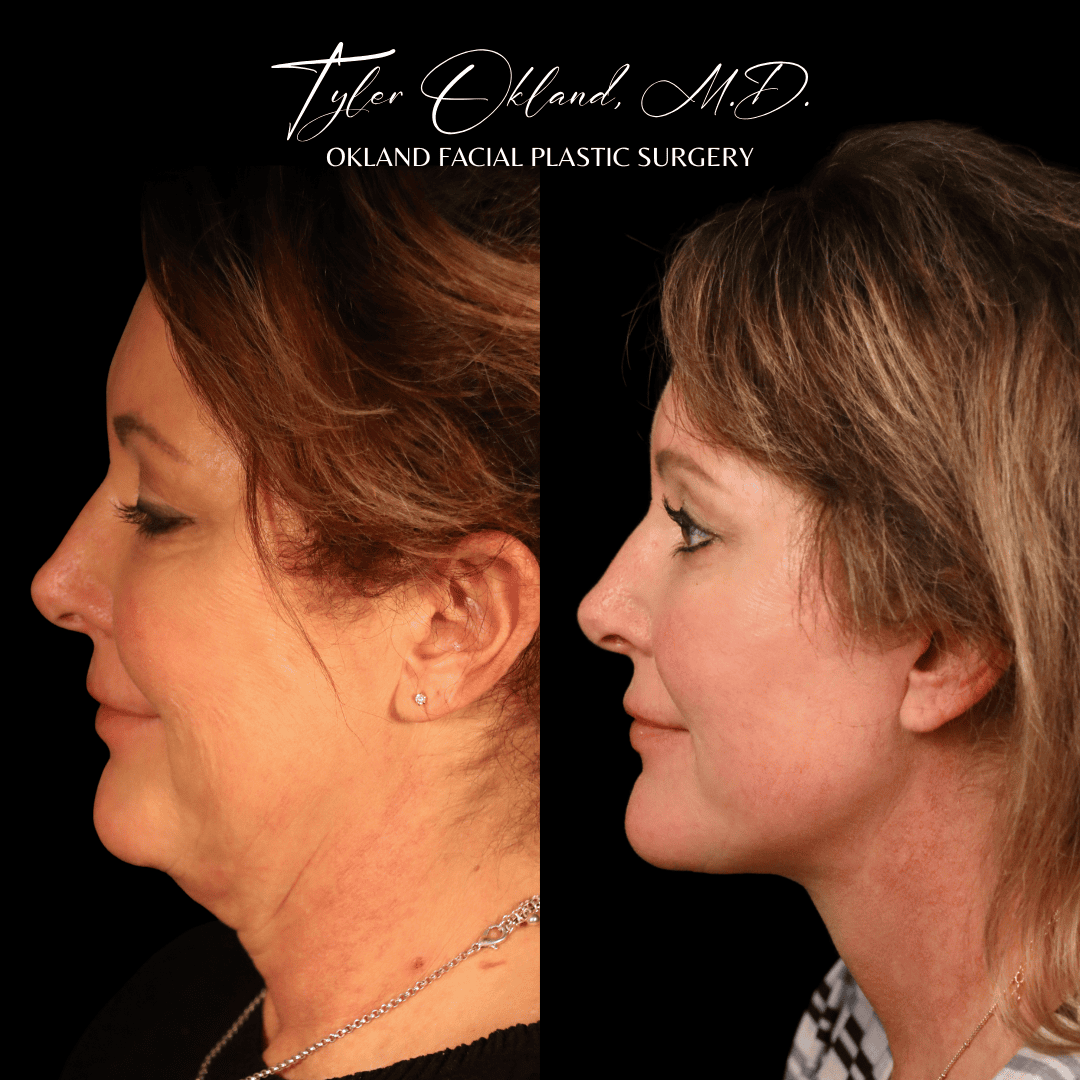
Scroll to compare results
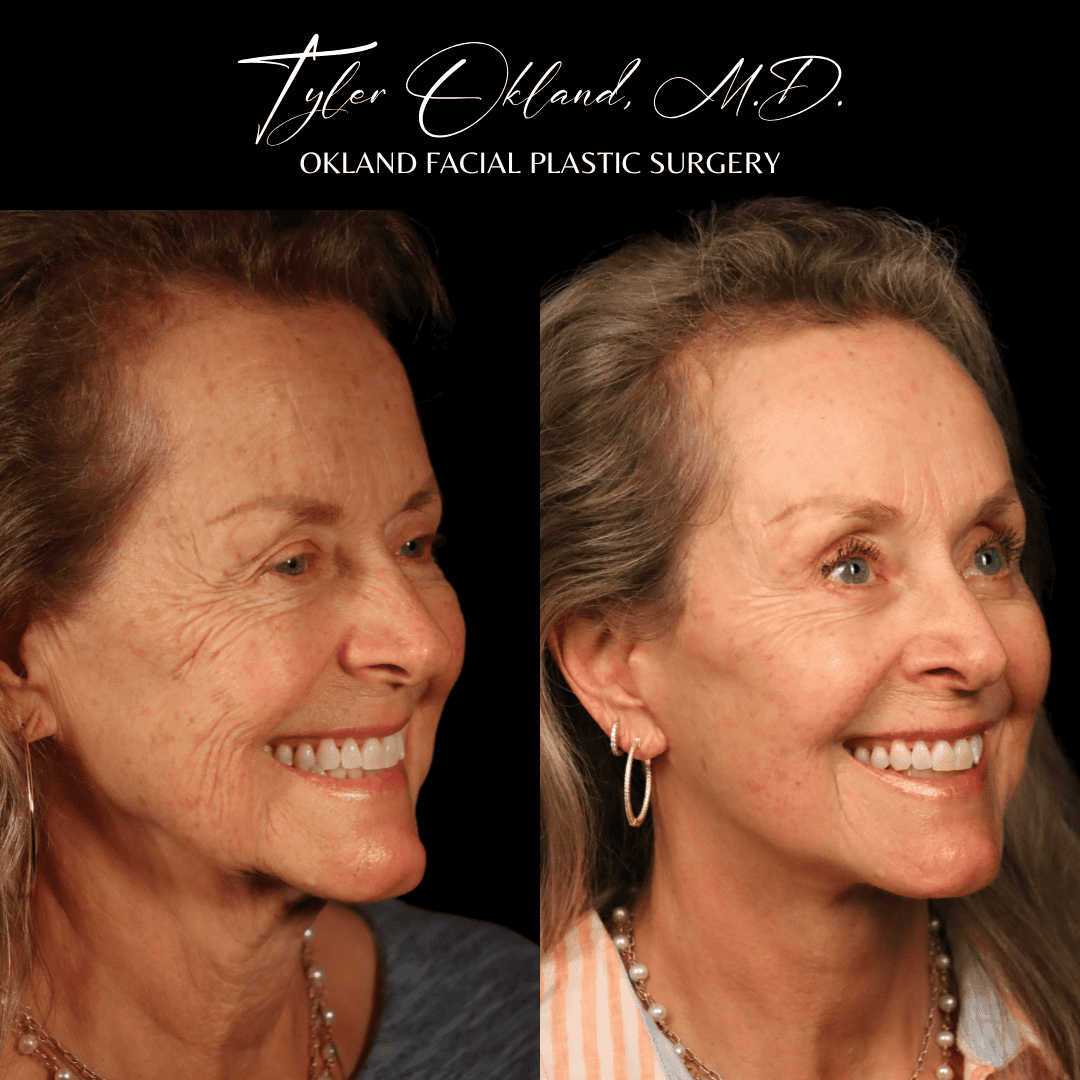
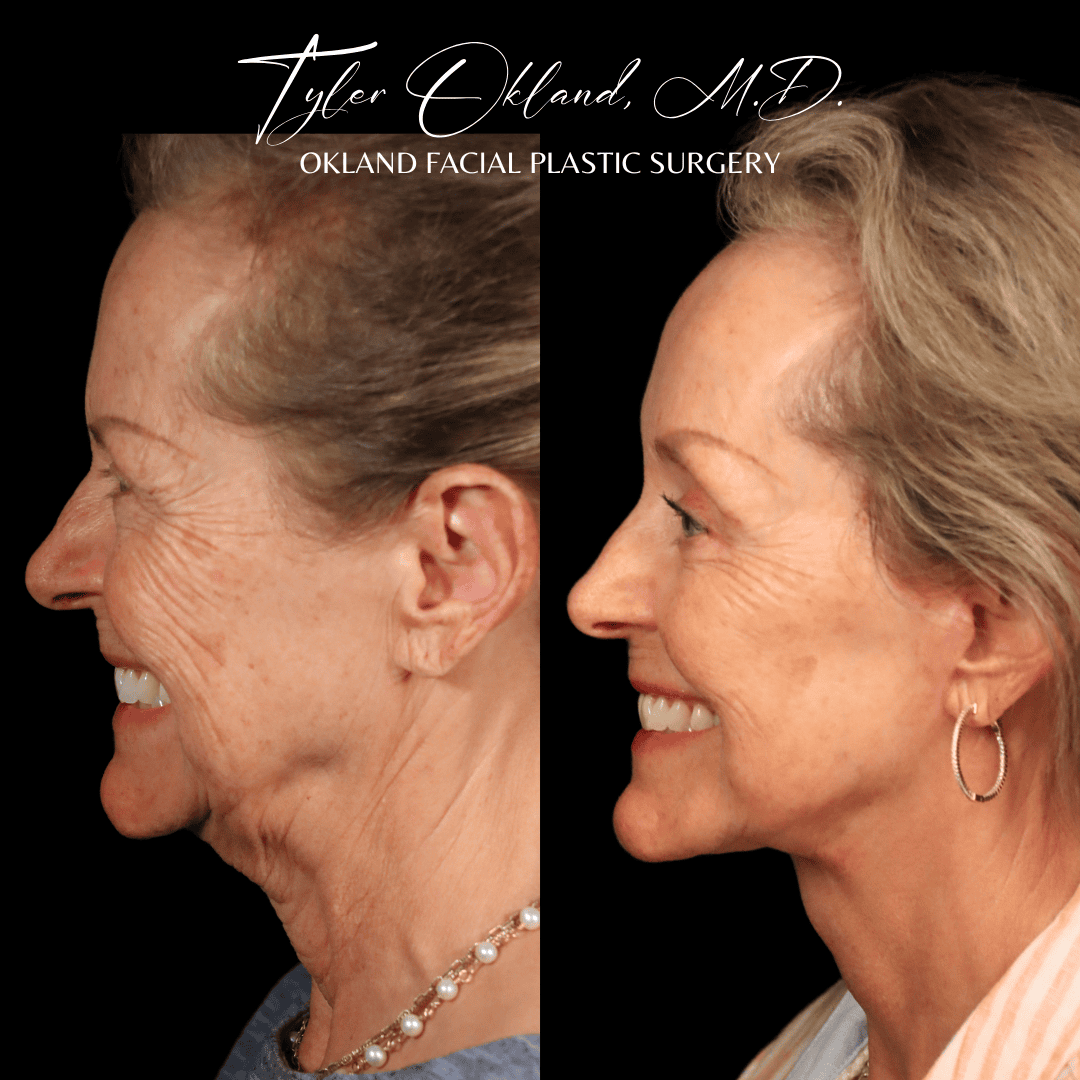
AGE 63 | FOLLOW-UP 4 MONTHS | PATIENT TRAVELED FROM PLANO, TEXAS
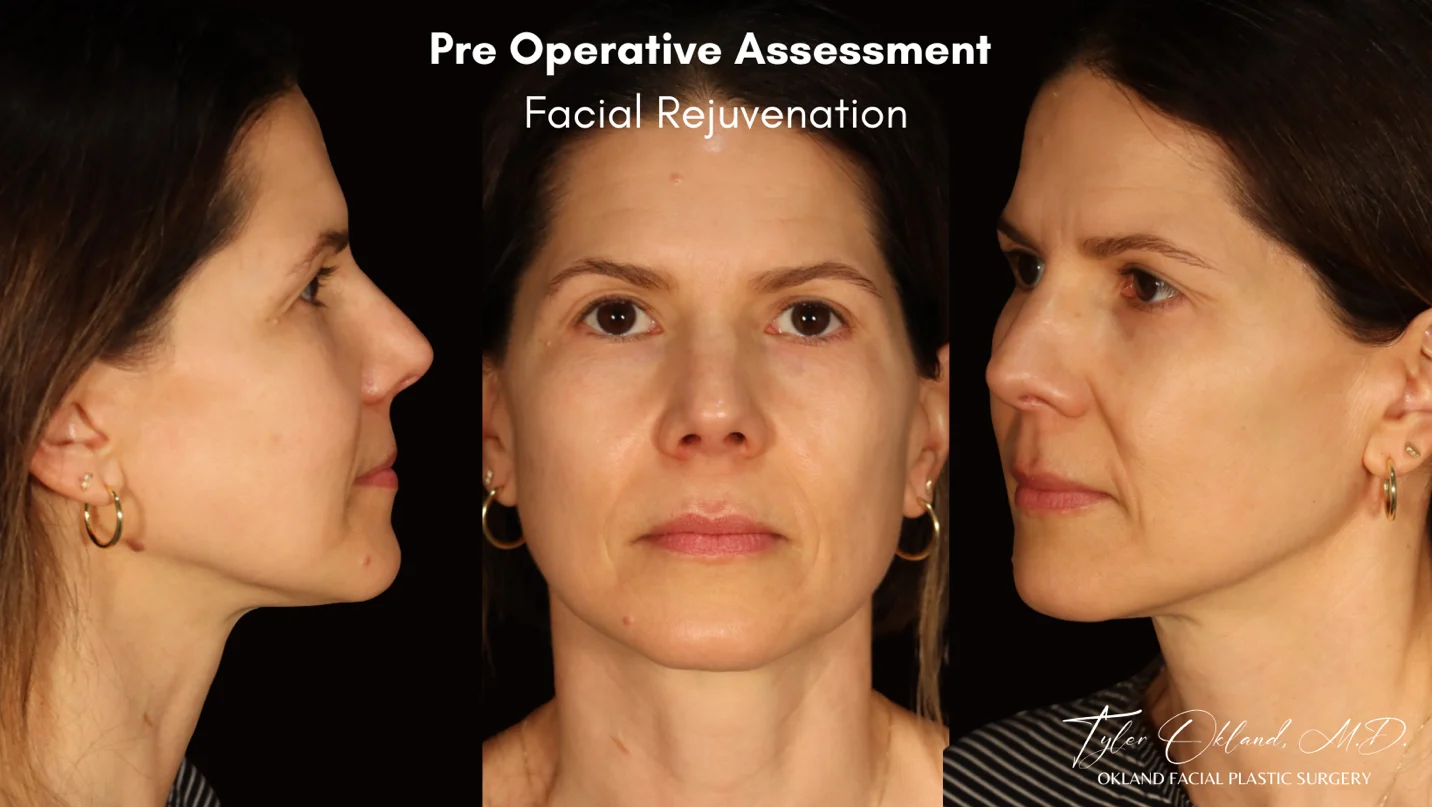
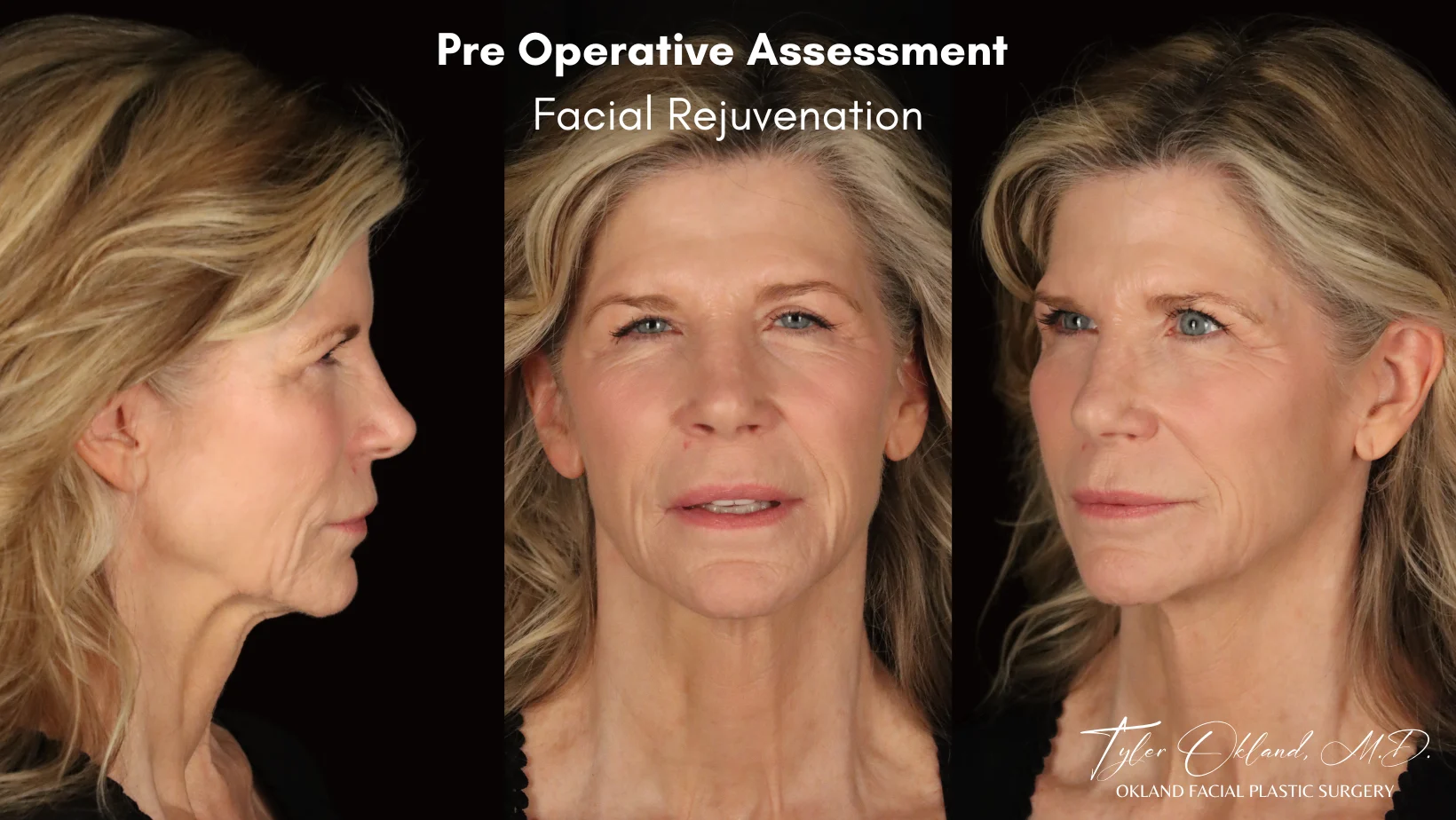
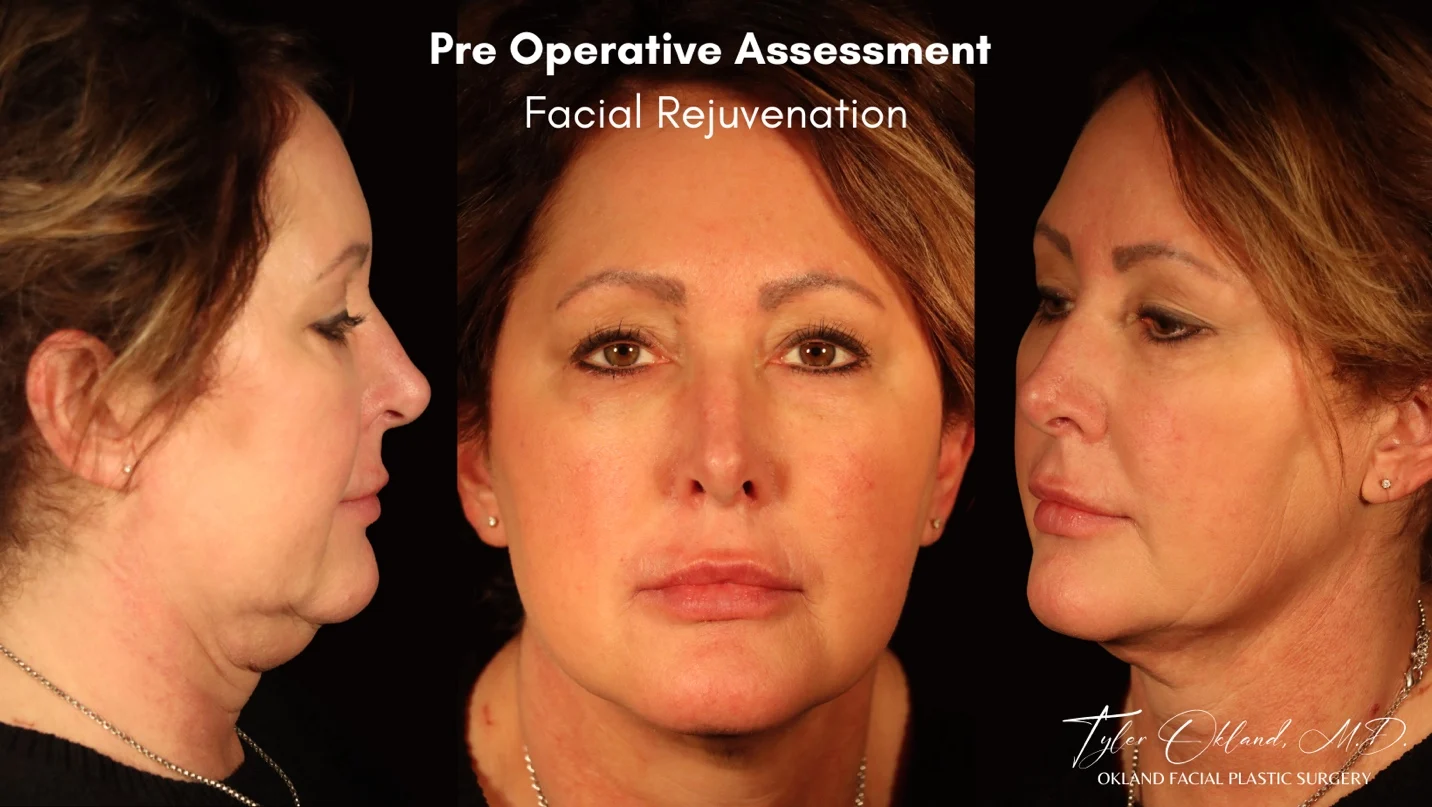
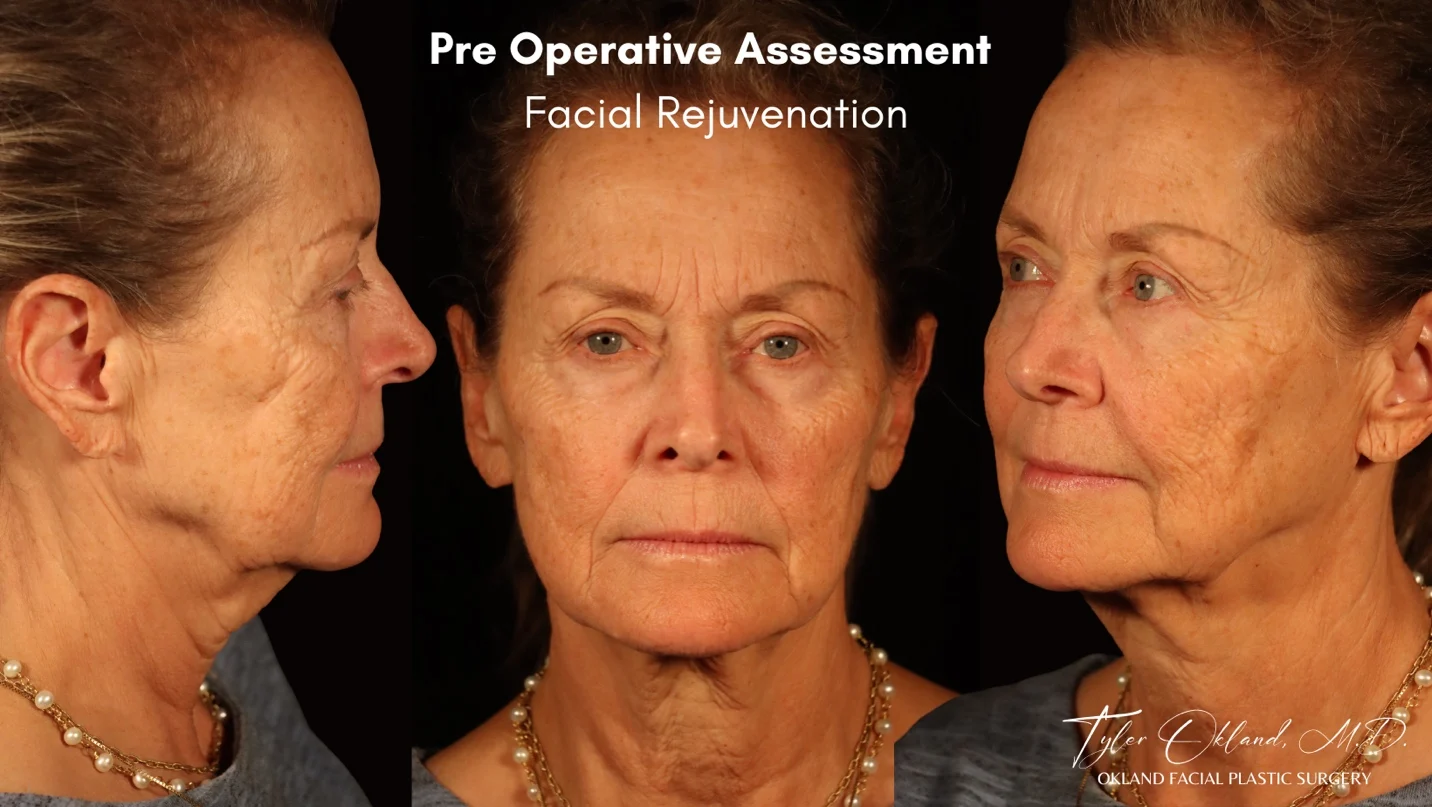
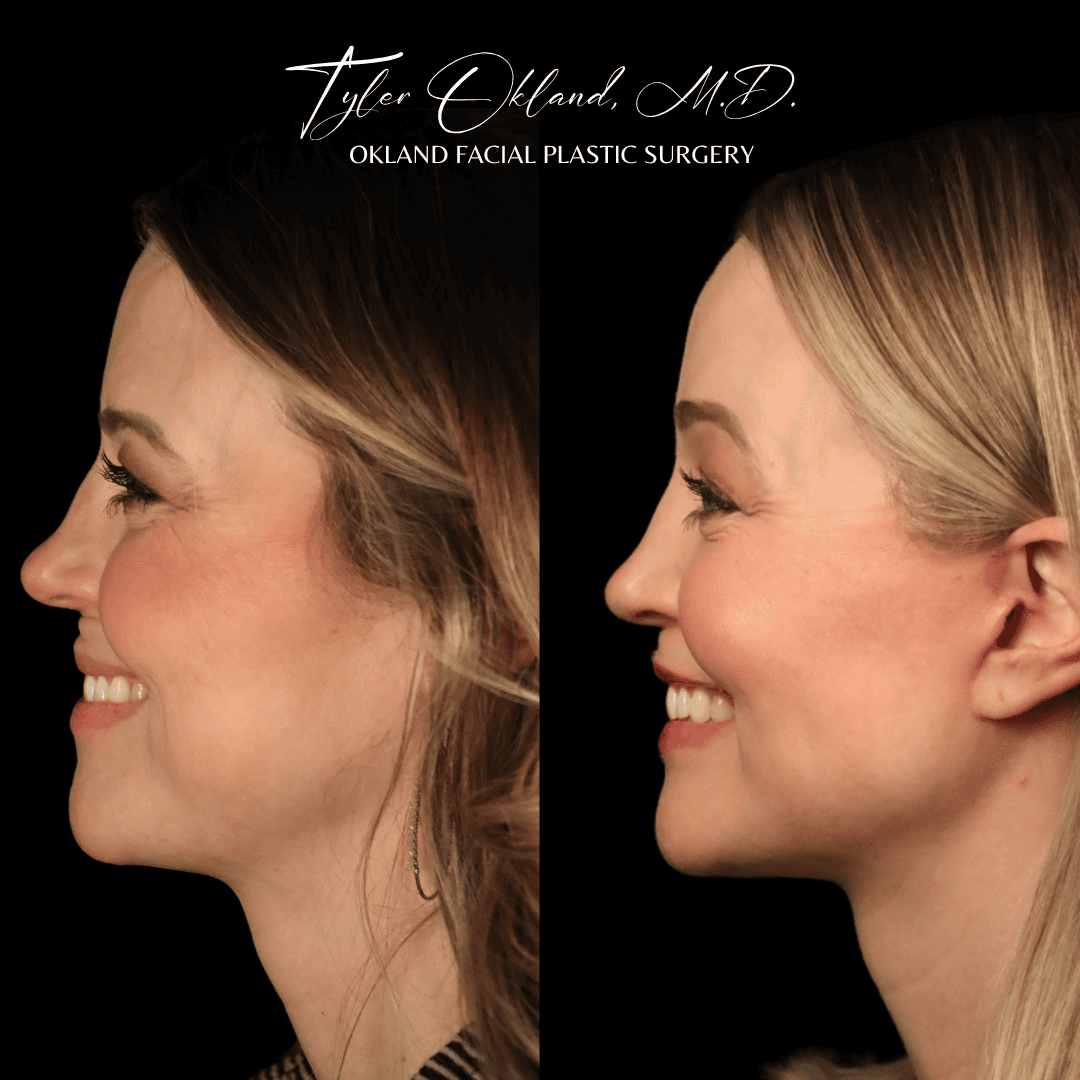
She had always been beautiful, had always taken excellent care of herself, and remained extremely fit. But over the preceding five to ten years, she felt that the aging of her eyes and lips had begun to change the way she looked and, increasingly, the way she felt about her face. She did not want to look different. She wanted to look like herself again.
|
Preoperative assessment views |
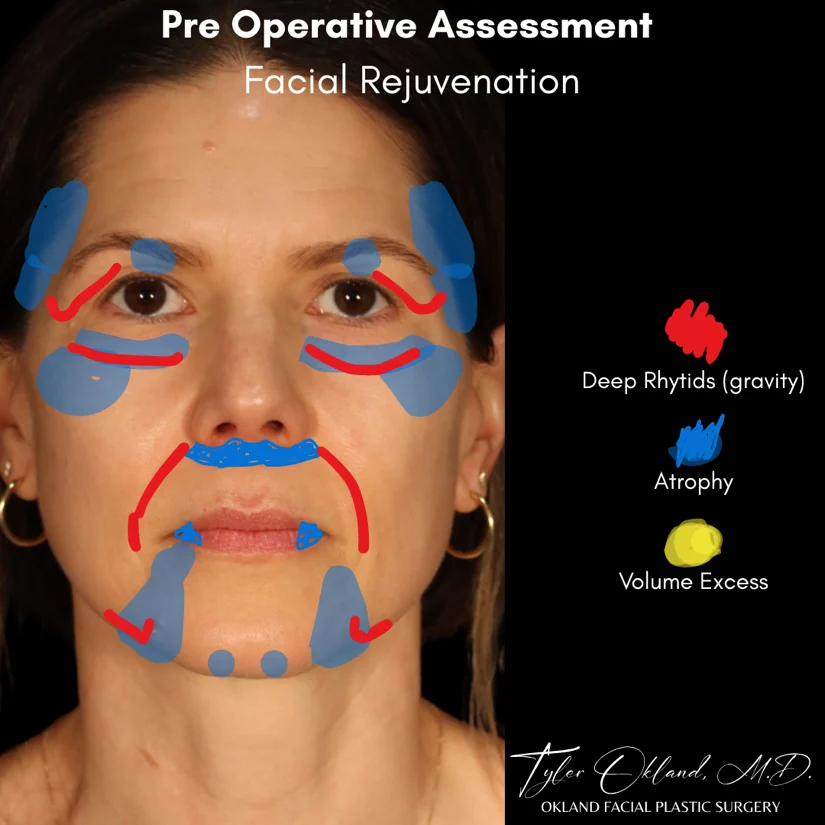
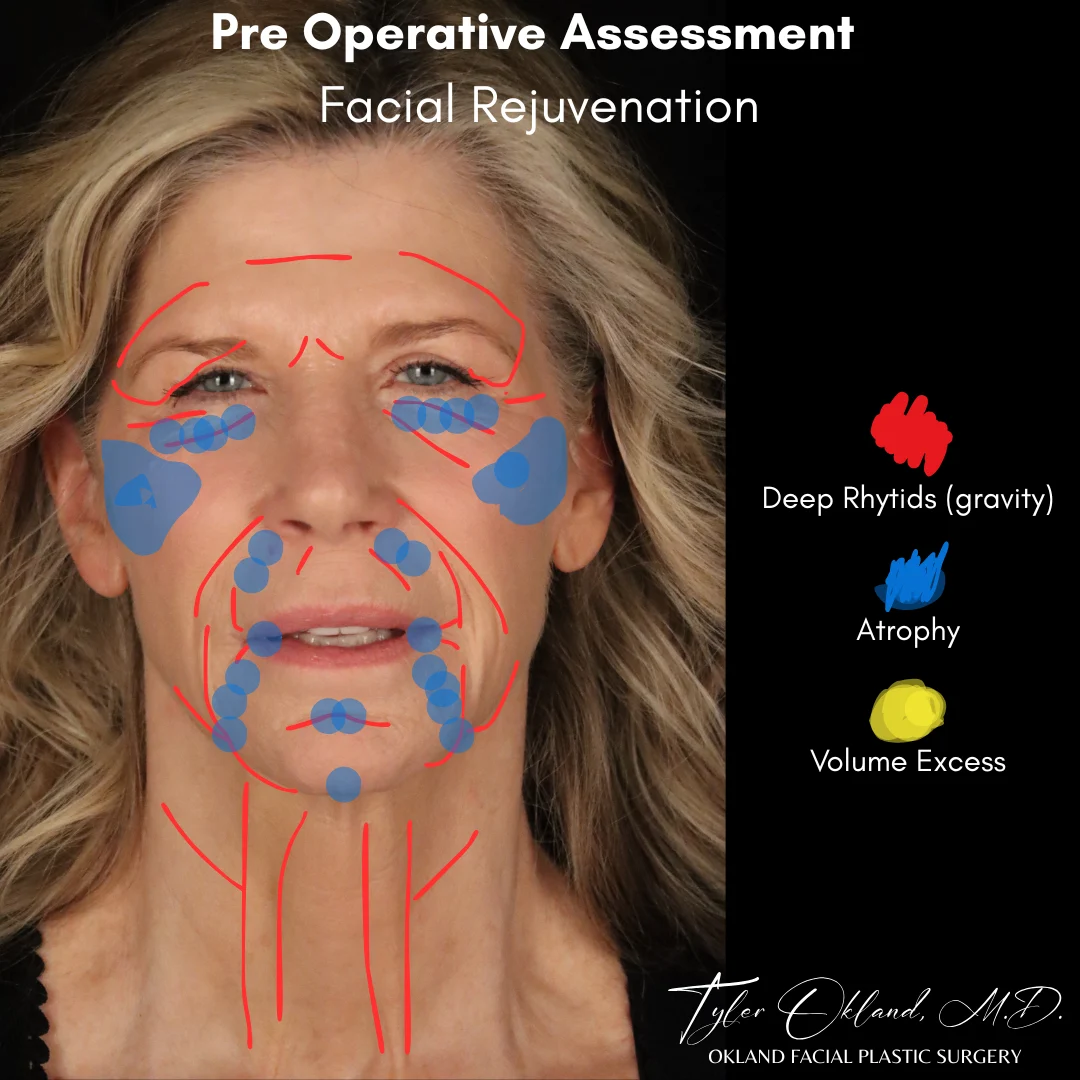
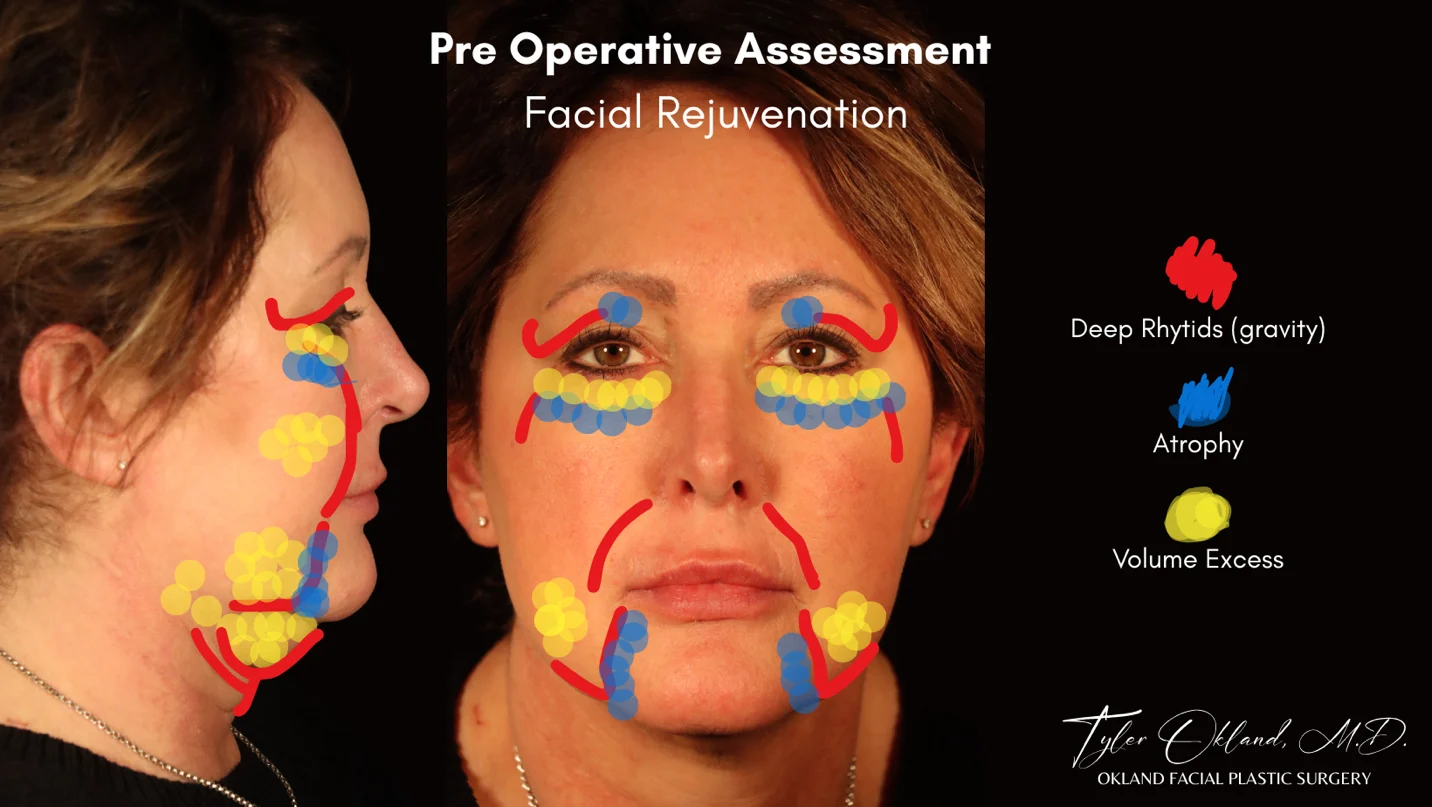
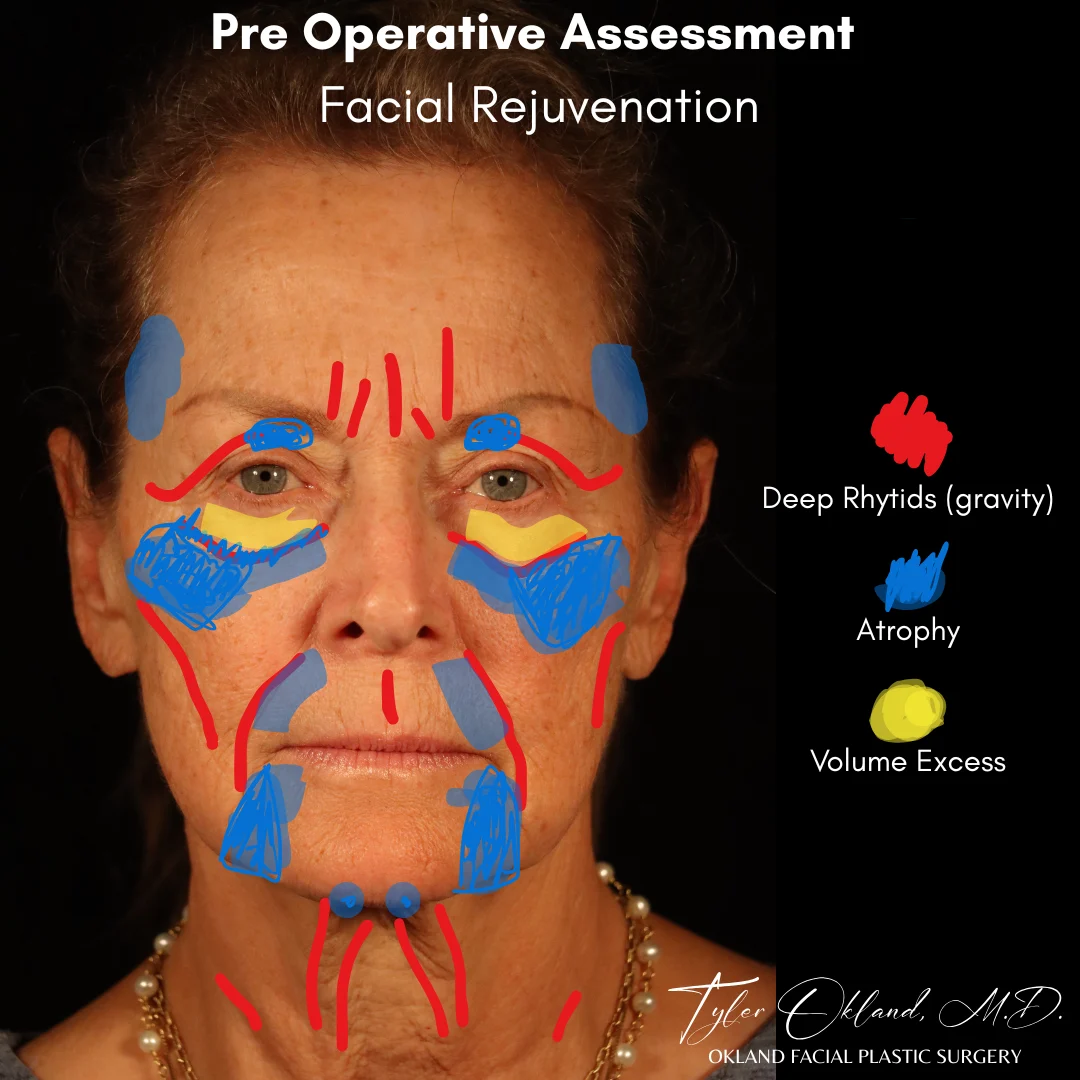
Diagnostic overlay: descent and volume loss |
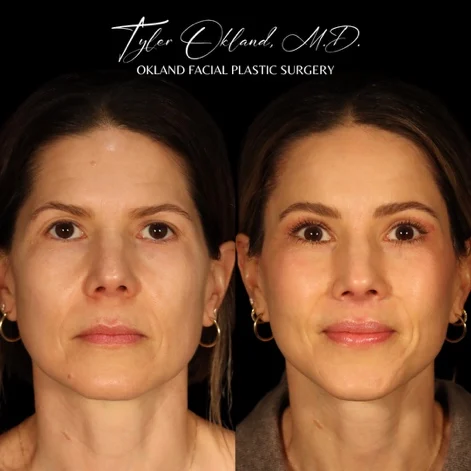
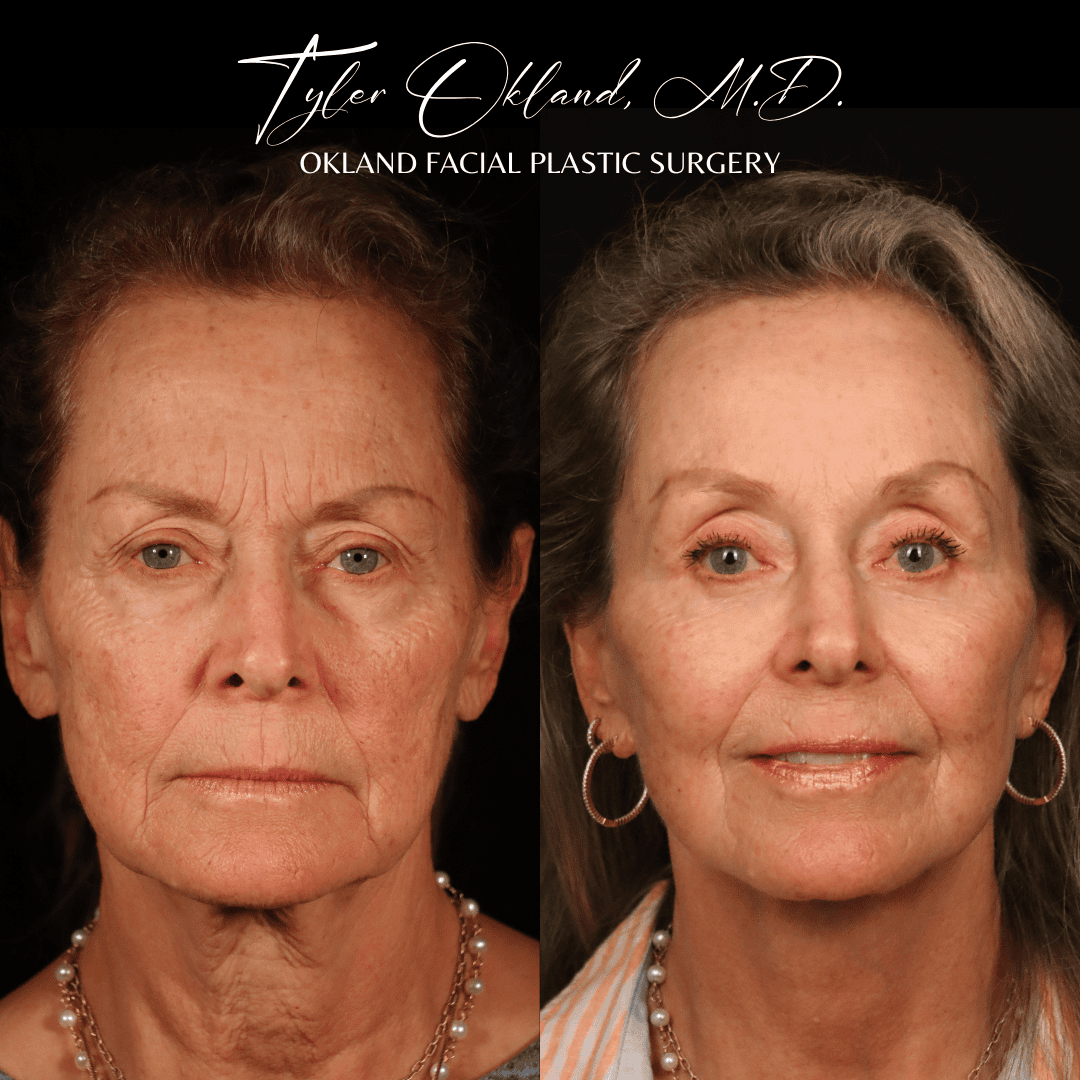
Frontal result at 4 months |
|---|
Her neck aging was driven primarily by active platysmal banding rather than excess fat. She also had midface descent, significant brow ptosis with right-greater-than-left asymmetry, a long upper lip, and volume loss through the temples, tear troughs, piriform regions, cheeks, prejowl sulci and chin. Prior four-lid blepharoplasty and prior lip fat transfer created additional constraints I had to work around rather than ignore.
Extended deep plane facelift
Deep neck lift
Endoscopic brow lift with two Endotine fixation devices
Lip lift
Full-face fat transfer
Septoplasty
There was essentially nowhere on her face where I wanted to remove fat. I instead planned to restore volume strategically while correcting the brow, platysma and upper-lip length. I lifted slightly more on the right brow to improve asymmetry, performed a conservative lip lift because she already showed upper teeth at rest, and placed most lip fat laterally to improve red-lip eversion without worsening the preexisting fullness of the white upper lip from her prior fat transfer.
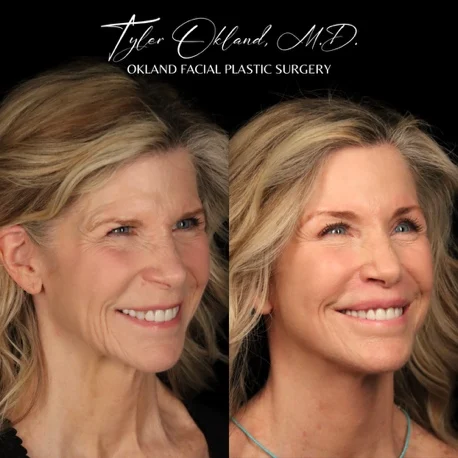
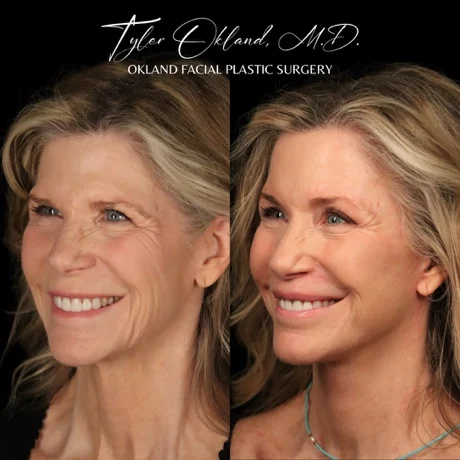
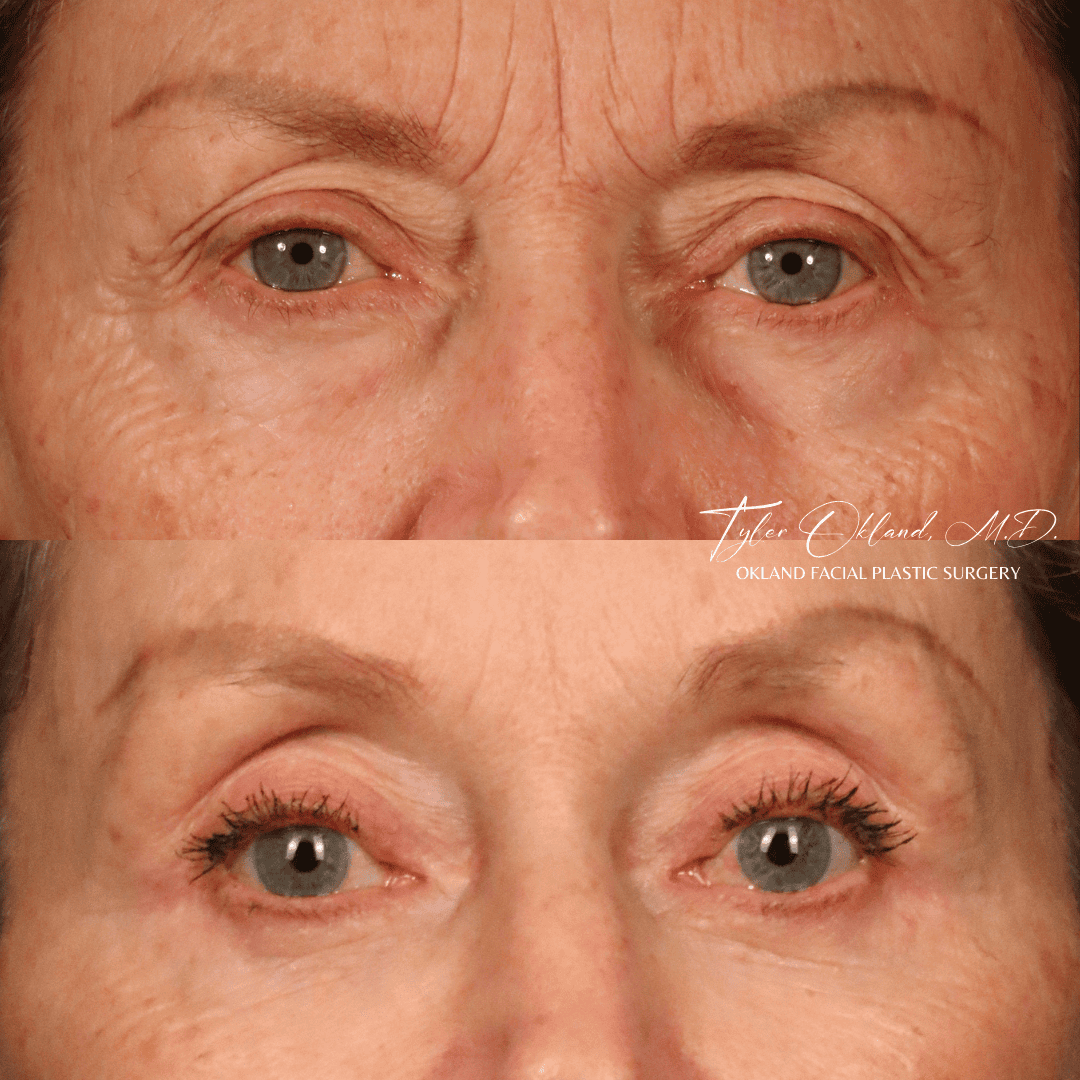
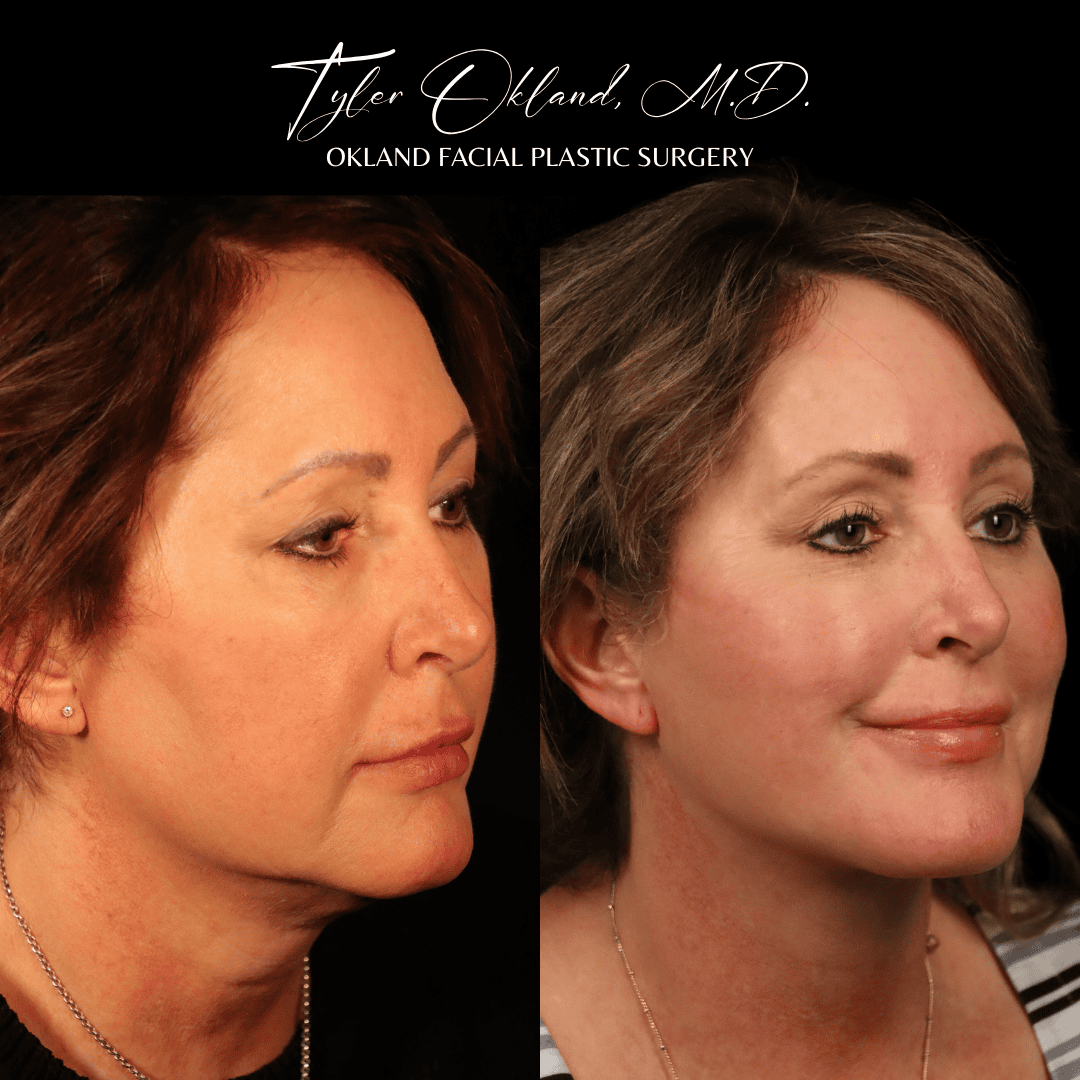
Fuller. More symmetric. More refreshed. But perhaps the most striking change is that her entire face simply looks more relaxed. Her smile looks effortless, the eyes are more open and symmetric, the central platysmal banding has been eliminated, the jawline is clean, and the chin has more structural presence while remaining incontestably feminine.
My favorite view is the three-quarter view. It exposes the relationship between the lower eyelid, cheek, midface, mouth, chin, jawline and neck simultaneously. In her postoperative three-quarter view, she has regained an elegant ogee curve, a high crisp lid-cheek junction, forward rather than downward chin projection, and one continuous jawline with excellent negative space beneath it.
She is strikingly beautiful, but I cannot take credit for that. She looks like herself. That is the point.
|
Three-quarter smiling view |
Three-quarter smiling view |
|---|---|
|
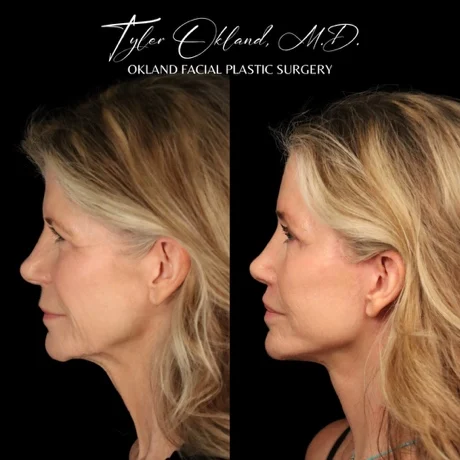
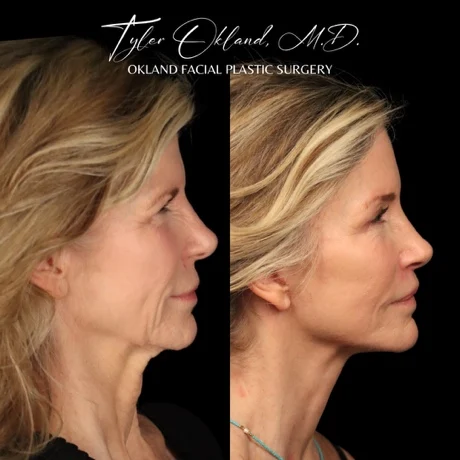
Profile comparison |
Opposite profile comparison |
Facial aging involves skin, distinct fat compartments, the superficial musculoaponeurotic system—or SMAS—retaining ligaments and the deeper anatomy of the neck.
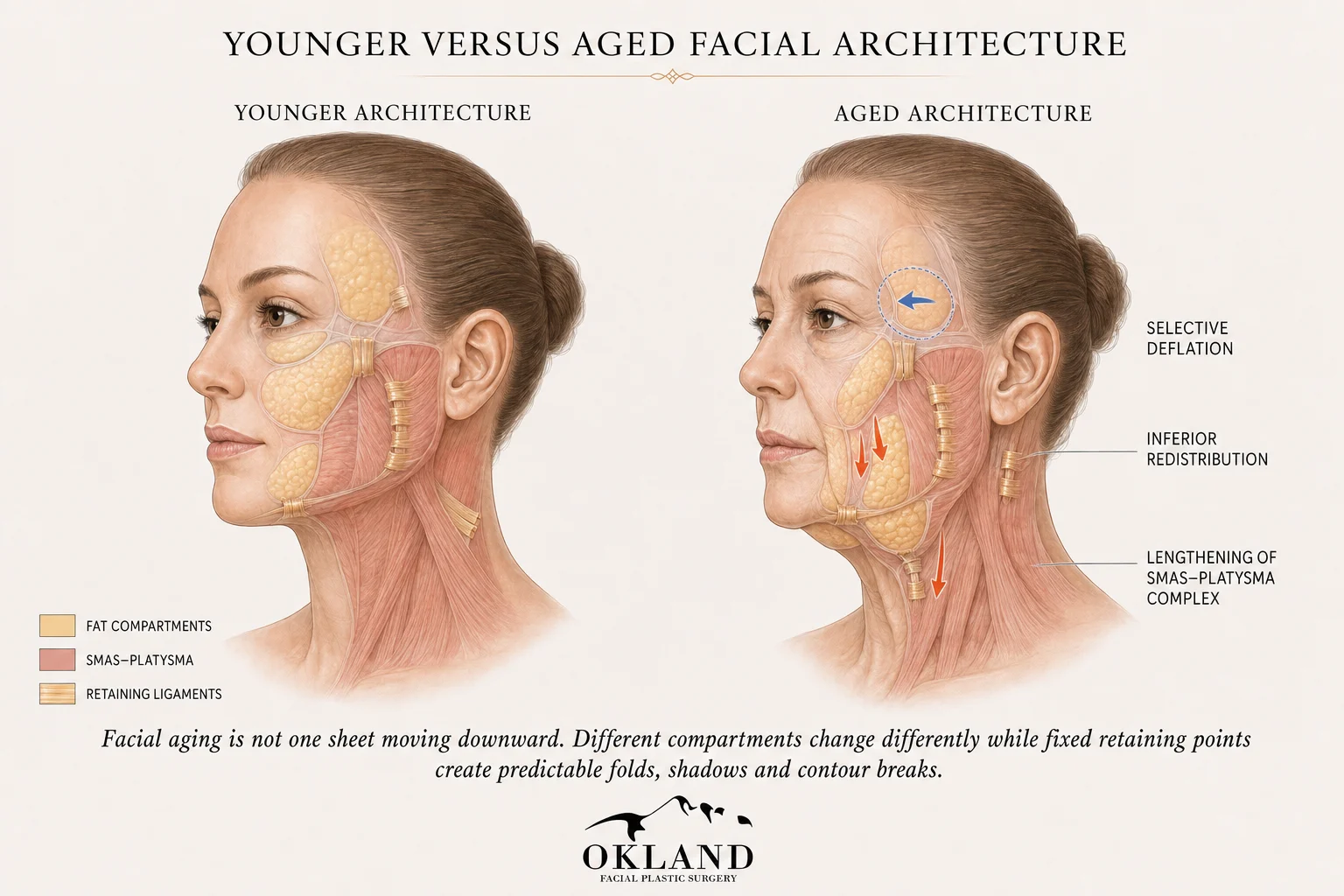
Younger versus aged facial architecture.
Facial fat is organized into separate superficial and deep compartments. They do not age uniformly. Some deflate, some descend or redistribute and others appear relatively heavier as surrounding areas lose volume. Generally, the aging face becomes hollow through the temple and upper cheek while becoming heavier around the mouth and jawline.
The SMAS is the most important anatomical structure for a facelift surgeon. It is a three-dimensional fibromuscular layer connecting the skin and superficial fat to the muscles of facial expression. Below the jawline, the SMAS is continuous with the platysma. Together, they form a connected structural system from the cheekbones through the neck.
The lateral SMAS near the ear is relatively fixed. The tissue farther forward is more mobile but tethered by retaining ligaments. Tightening tissue near the ear is not anatomically equivalent to releasing and repositioning the descended cheek, nasolabial fold and jowl.
Younger versus aged facial architecture.
Retaining ligaments connect the superficial tissues to deeper fascia or bone. They are valuable supports in youth, but as surrounding tissue descends they become fixed boundaries around which folds and contour breaks form. Pulling harder from the side does not efficiently move tissue that remains tethered by ligaments. The relevant attachments must be released.
Zygomatic retaining ligament
Masseteric retaining ligament
Mandibular retaining ligament
Cervical retaining ligament
Each must be released to allow tension-free suspension of the composite tissue in extended deep plane facelift surgery.
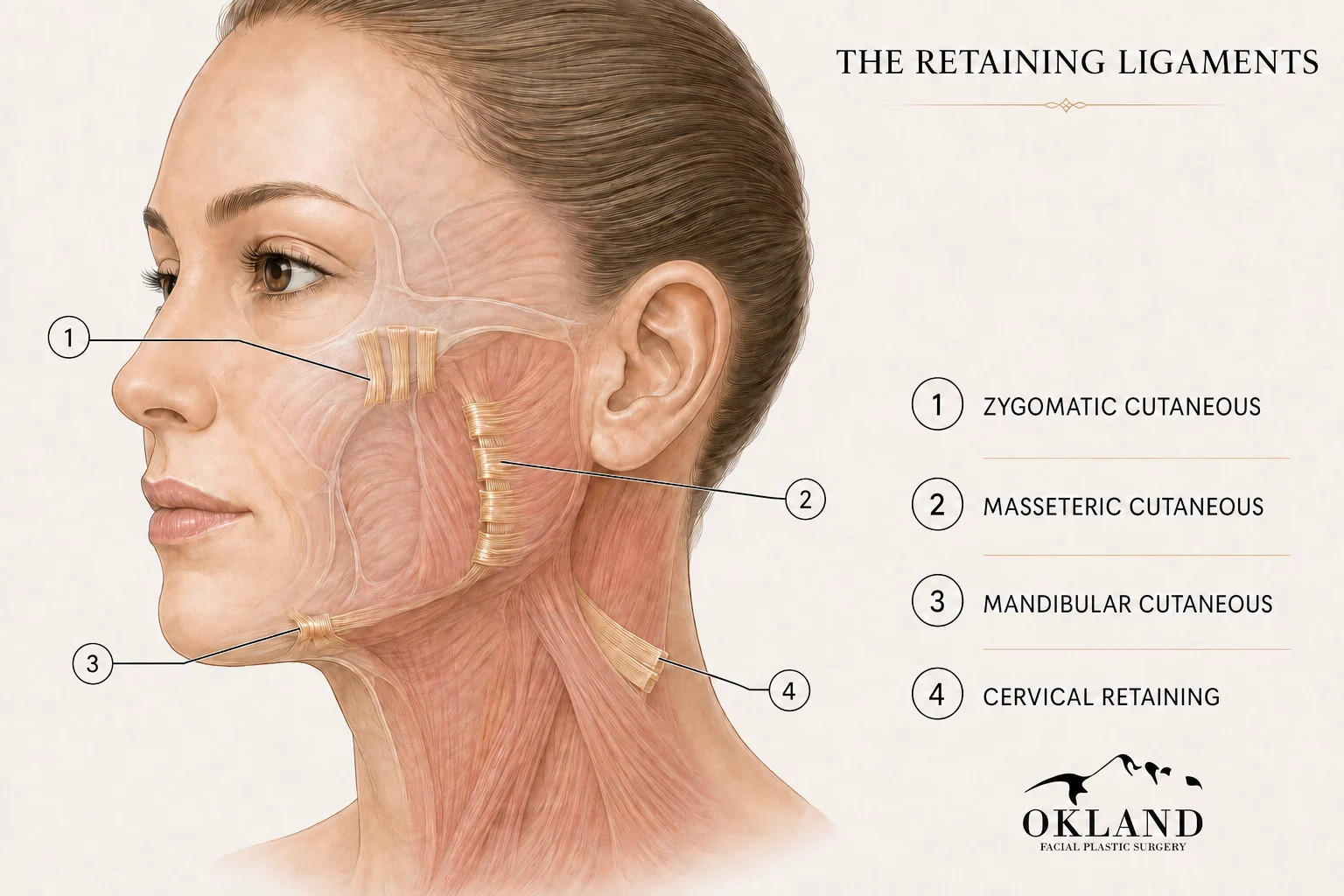
The four retaining ligament systems emphasized in Dr. Okland’s extended deep plane approach.
The deep plane is the surgical corridor beneath the SMAS and above deeper structures, including branches of the facial nerve. Entering this plane does not, by itself, merit calling an operation a deep plane facelift. The meaningful questions are where the surgeon enters, how far the dissection extends and which ligament systems are actually released.
Younger versus aged facial architecture.
The words on a website cannot prove what happens in the operating room. Ask the surgeon to point on your face to the extent of the dissection field, identify the retaining structures released, explain exactly how the neck is treated and show mature results across many different patients.
Look for standardized frontal, profile and three-quarter results—not only flattering angles.
Study whether the patient still looks immediately recognizable and whether the mouth, eyes and earlobes remain natural.
Ask to see mature scars from both sides with the hair pulled completely away from the ears.
Ask whether the face and neck are treated as one operation and what determines whether deep-neck structures require contouring.
Ask how the surgeon diagnoses facial atrophy and whether volume restoration is part of the plan rather than an afterthought.
Study a body of work, not a single best result. No two faces should look the same; the quality of judgment should be consistent.
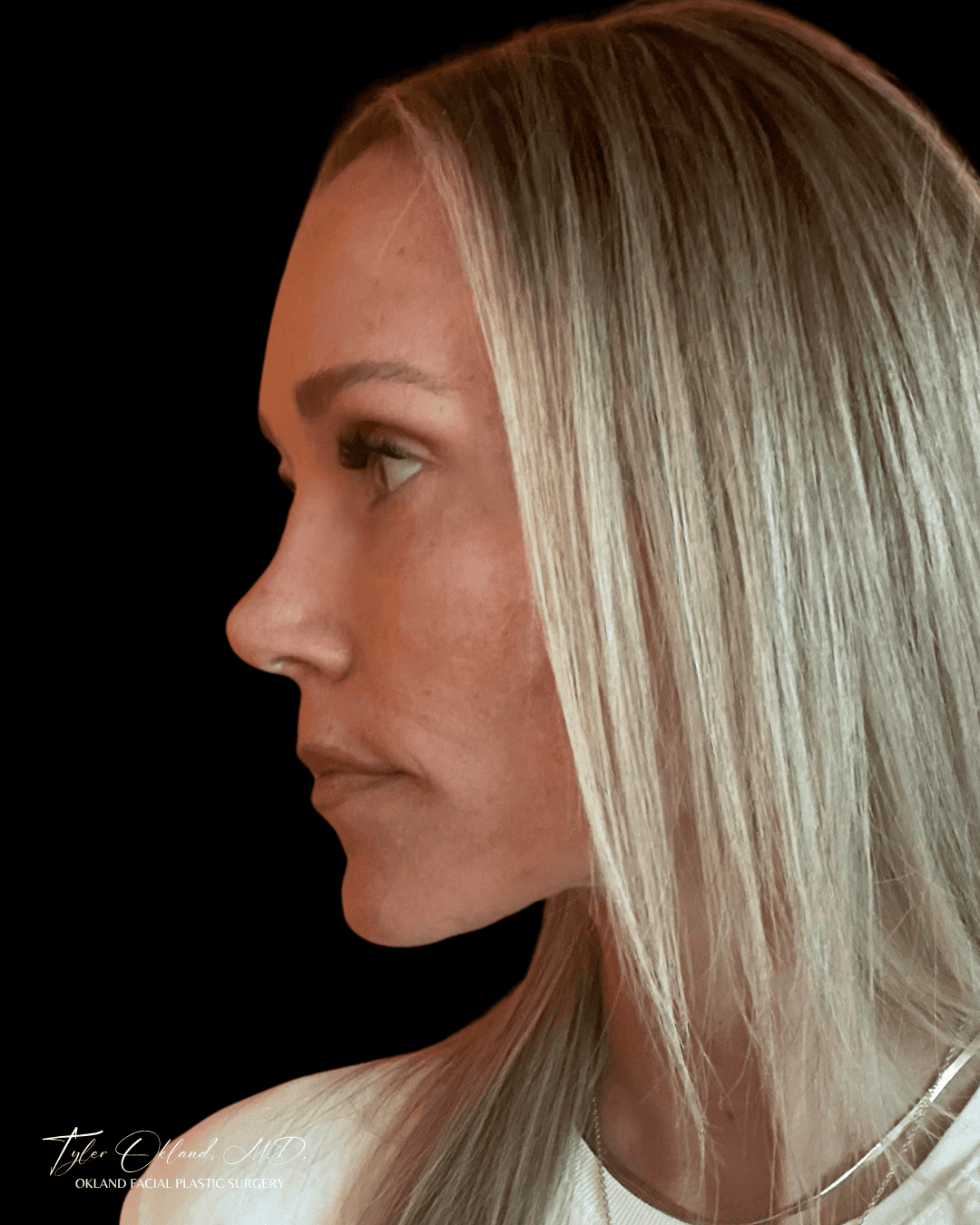
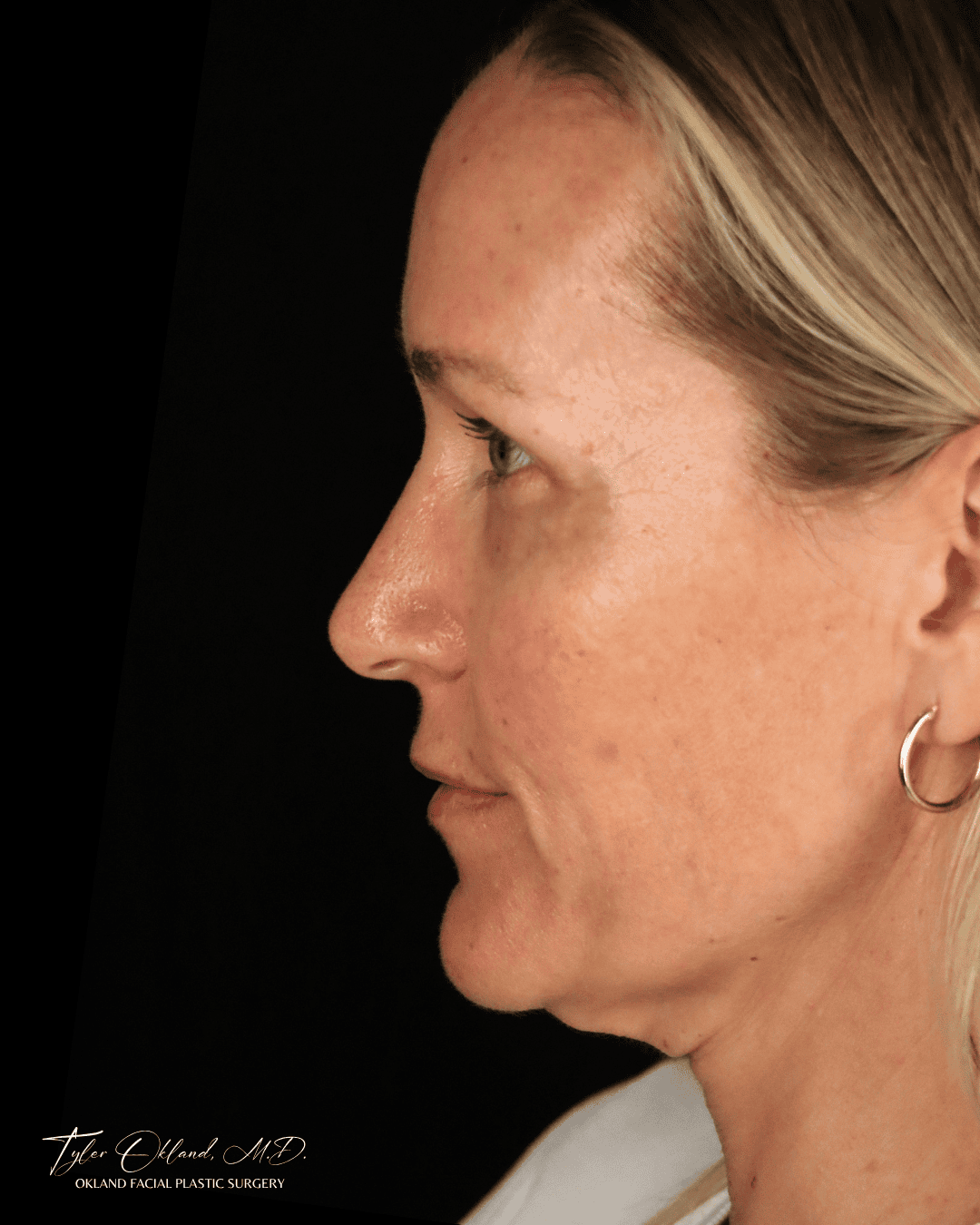
The anatomy, scars and outcomes should tell the same story.
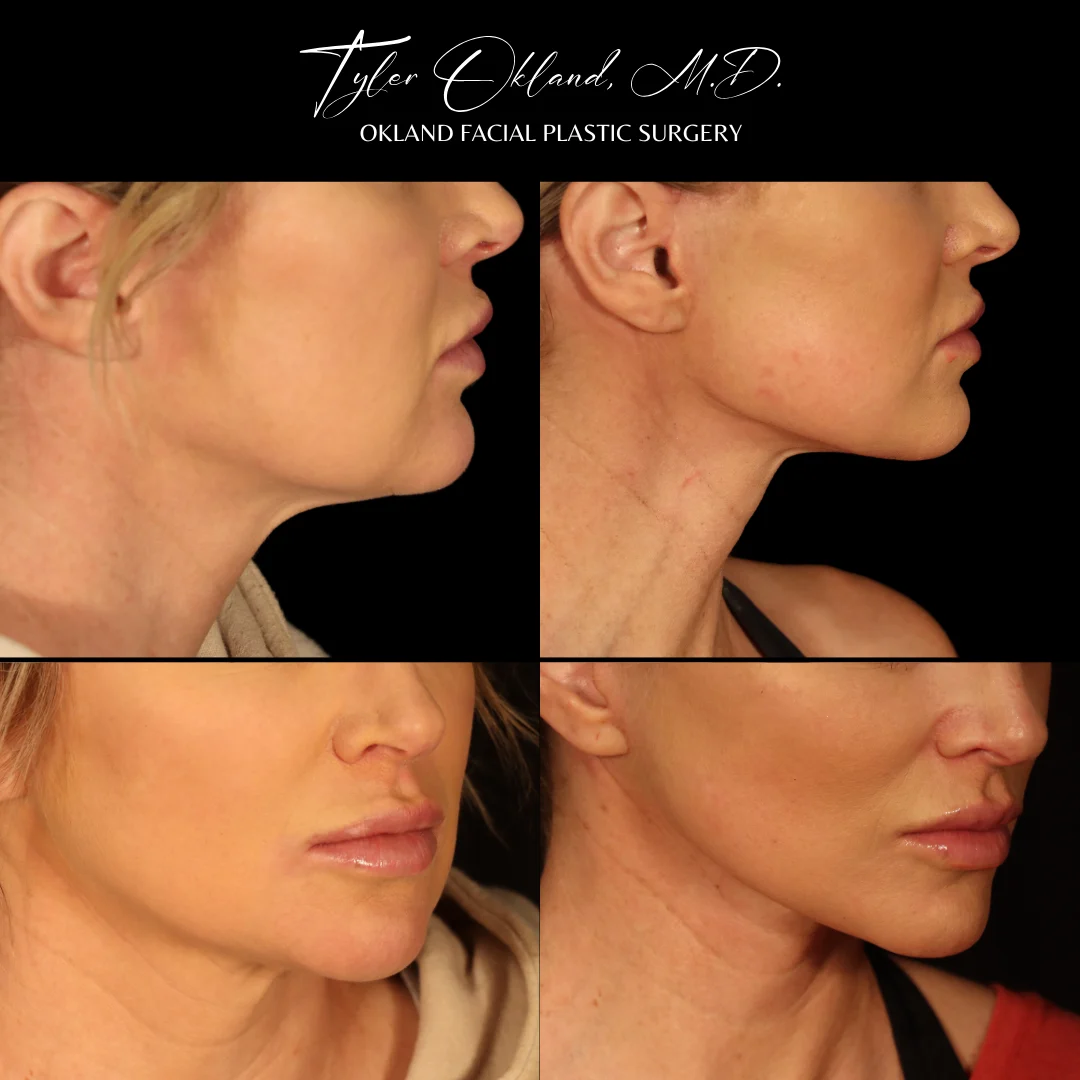
Neck aging may involve superficial fat, platysmal laxity or banding, subplatysmal fat, digastric prominence, submandibular glands, skin excess and skeletal anatomy. These are not interchangeable problems. A comprehensive deep neck lift diagnoses which structures are obscuring the cervicomental angle and treats only what requires correction.
This is why the facelift and deep neck lift are inseparable in my practice. Rejuvenating the face while leaving the neck untreated would produce an underdone result. I am not here for better. I am here for the best possible result.
“Preservation” does not mean performing less surgery. It means preserving blood supply, connective tissue and normal relationships where doing so makes the operation safer or the result more natural. Modifications such as the sailboat technique, Roskie’s patch and the mastoid crevasse are refinements in flap design, vectoring and neck fixation. They matter because they improve how a comprehensive operation is executed; they do not substitute for adequate release.
Gravity gets all the blame for aging, but its partner in crime is at least as responsible.
Gravity changes where tissues reside: the cheek descends, the jawline loses definition and fullness accumulates around the mouth and jowl.
But atrophy—the loss of good fat in the face—removes volume from the temples, brow, orbit, cheeks, chin and other areas that once gave the face support, proportion and softness.
Simply reversing the vectors of gravity will leave the job half finished.
That is why individualized full-face fat transfer is included in every facelift I perform. It is not an upgrade or an optional line item. I consider volume loss part of the facial-aging diagnosis, so I consider its correction part of the operation.
“Full-face” means that no region is excluded from evaluation. I assess the temples, brow fat, orbital contours, tear troughs, cheeks, nasolabial folds, marionette regions, prejowl sulcus and chin. One area may need structural support, another only a transition softened and another no additional volume at all.
The objective is not to enlarge the face. It is to restore its architecture. Youth is read through proportion and the way light travels across the face—not arbitrary fullness. The patient should not look as though fat was added. She should simply look less hollow and more youthful.
Transferred fat is living tissue. Some initial volume is swelling, and not every transferred cell will establish a lasting blood supply. Survival varies by patient, region and the movement or shearing forces within the recipient bed.
I never over-inject fat in anticipation that some of it will disappear. Sometimes approximately half survives; sometimes nearly all of it does. Fat is permanent living tissue, and there is no off-button or easy way to remove what I transferred. I inject only to the level that looks appropriate—not beyond it. I would much rather have a patient return asking for more volume than return concerned that I placed too much.
The quality of fat transfer is not measured by the number of areas treated or cubic centimeters placed. It is measured by whether the final face looks more complete without looking larger, heavier or overfilled.
Some surgeons correct gravity in every facelift and address atrophy only when it appears conspicuous. I believe that demonstrates an incomplete understanding of facial aging. Once the lower face and neck are powerfully rejuvenated, untreated deficiencies may become more visible.
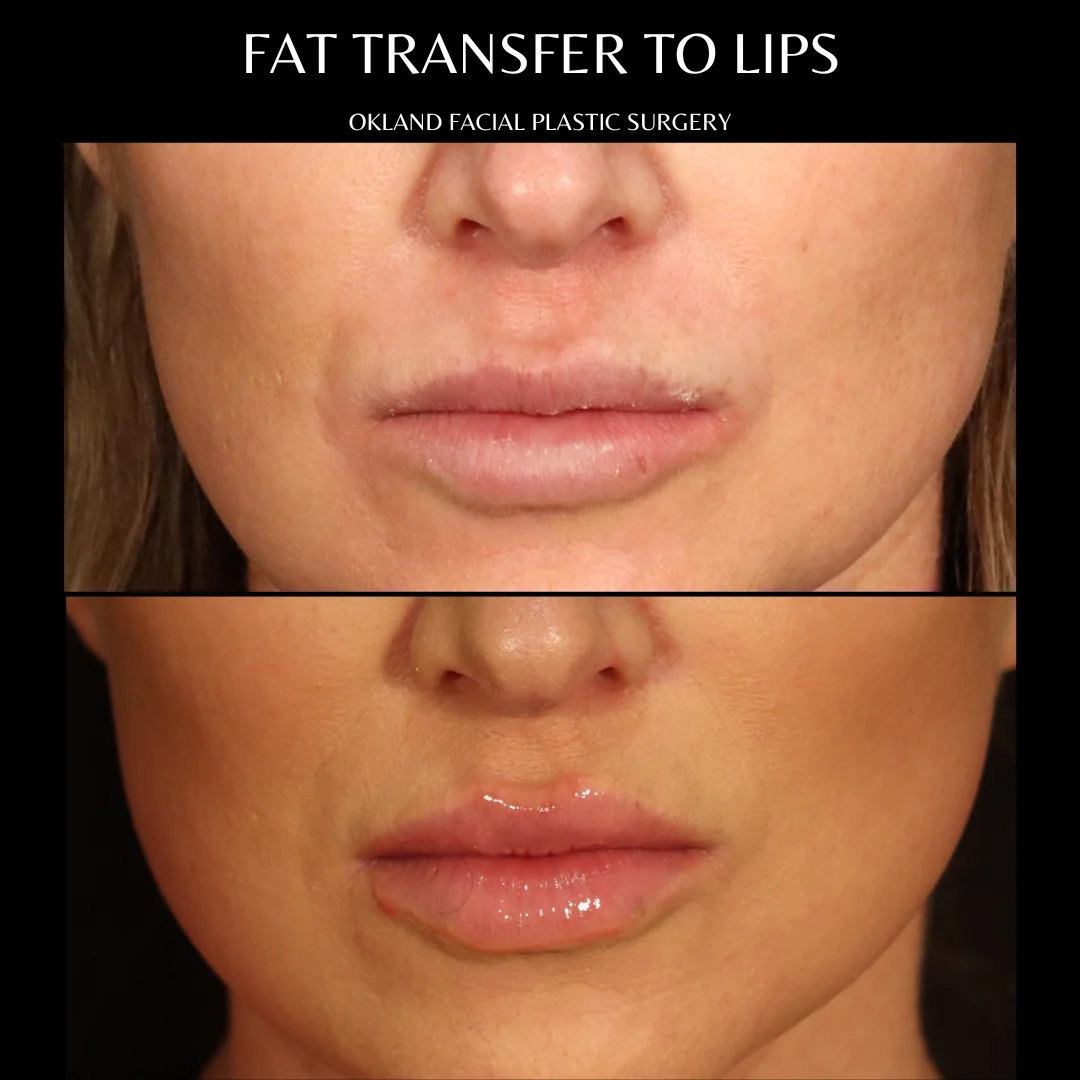
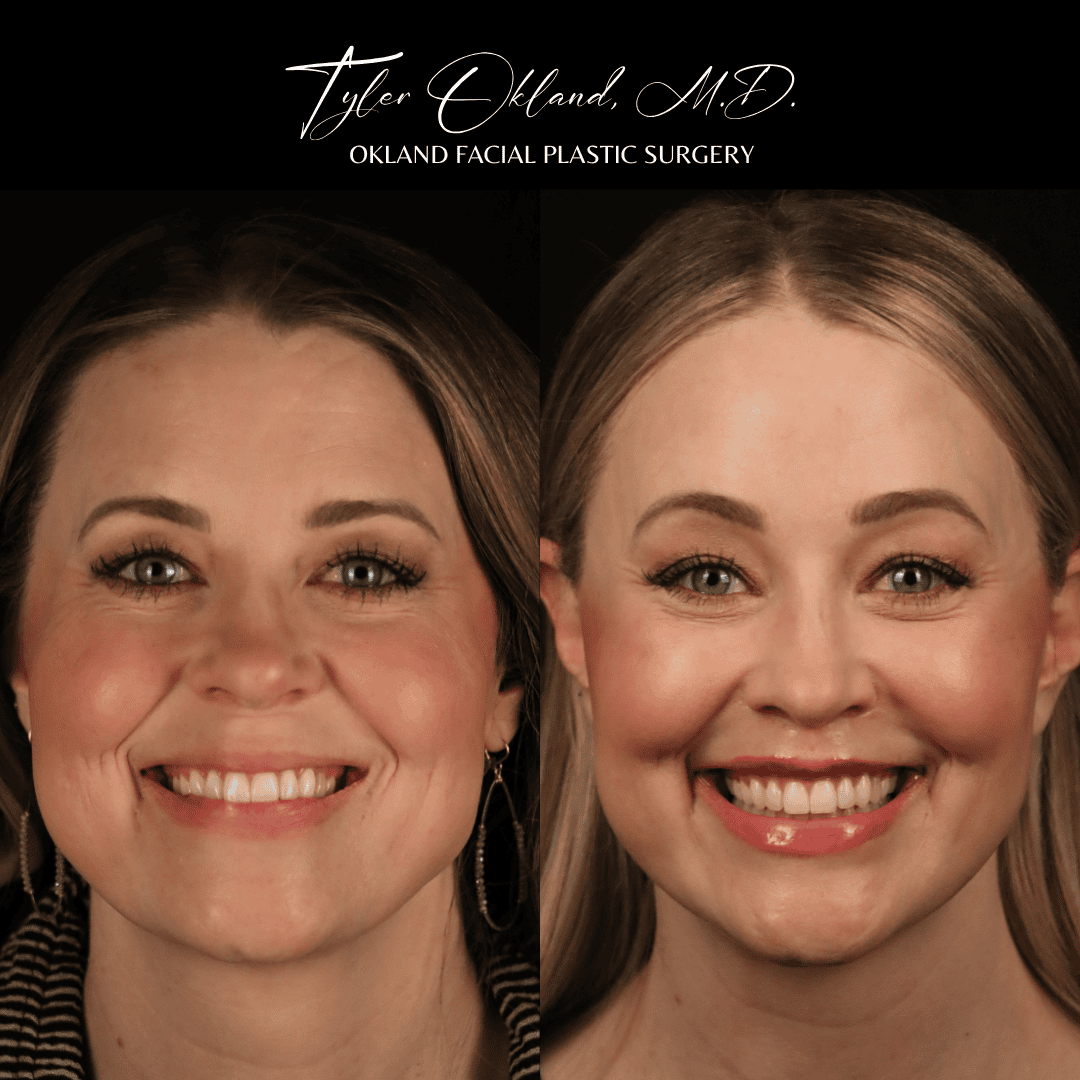
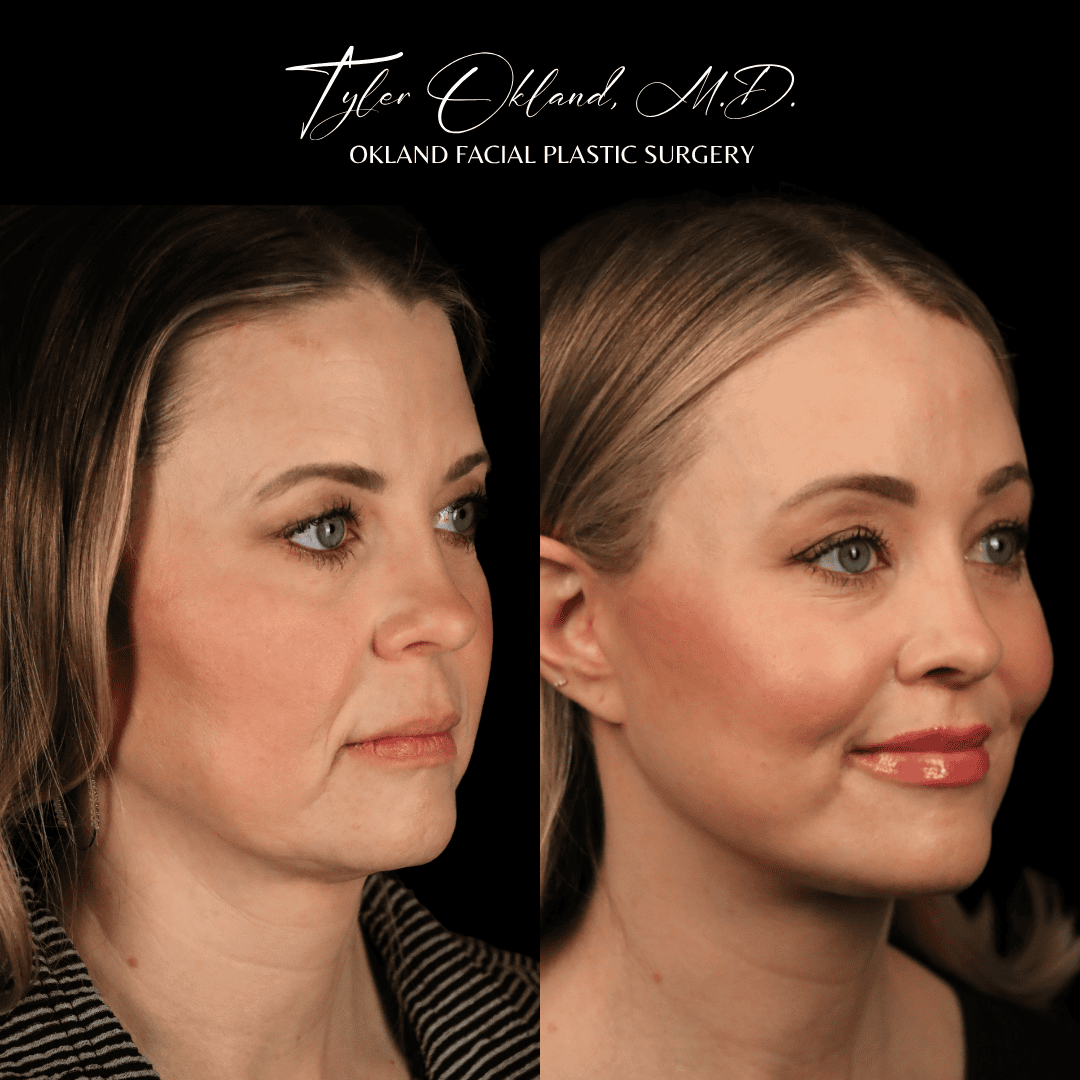
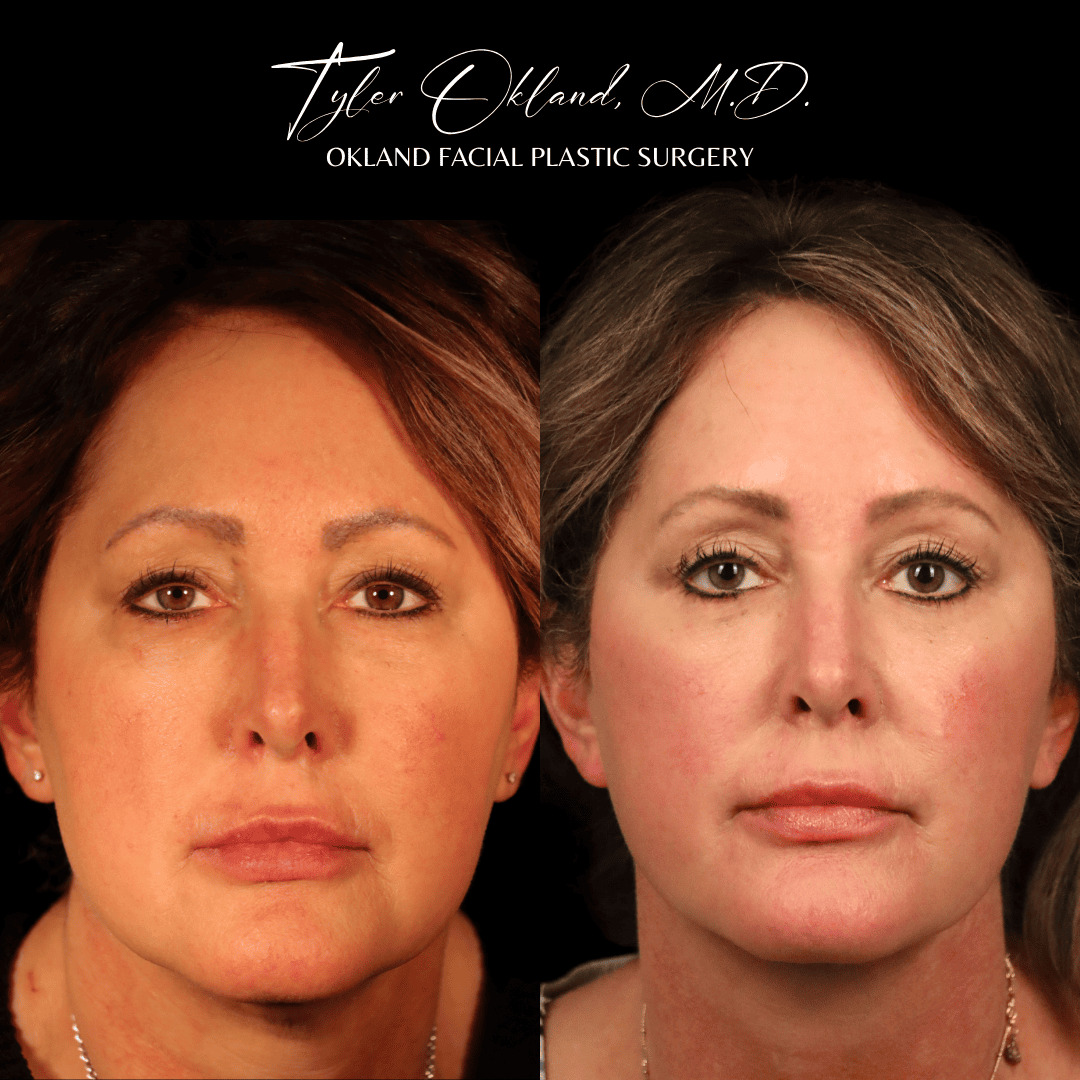
AGE 52 | FOLLOW-UP 7 MONTHS
Her primary concerns were heavy lower eyelid bags that made her look chronically tired and significant heaviness through the lower face and neck. This case is fundamentally about fat: she had too much volume in some regions and too little in others.
|
Preoperative assessment views |
Diagnostic overlay |
Frontal result at 7 months |
|---|
She had excess lower-eyelid fat, descent of the buccal fat pad into the jowl, and a large central neck fat pad. At the same time, her tear troughs were hollow and the prejowl sulcus and chin lacked the volume needed to create a seamless jawline. On profile, the marionette line extended past the jawline and created a wishbone deformity of the prejowl sulcus.
A facelift can reposition tissue. It cannot manufacture missing volume. She required a powerful vertical lift, lower blepharoplasty and deep-neck contouring—but also structural fat transfer beneath the eyes, into the prejowl sulci and into the chin.
Extended deep plane facelift
Deep neck lift
Transconjunctival lower blepharoplasty with no external skin incision
Full-face fat transfer
I harvested approximately 8 cc of usable fat from the lateral thigh: 1.5 cc to each prejowl sulcus, 1.0 cc to the piriform regions, 1.5 cc to each tear trough/zygoma region following lower blepharoplasty, and 1.0 cc to the chin.
Her marionette lines are dramatically softer, the jowls have been eliminated, the tear-trough hollowing is essentially gone, and the previously irregular jawline now reads as a continuous contour from the chin to the mandibular angle. My mastoid crevasse technique created front-to-back definition beginning at the angle of the mandible that may be better than it ever was.
At this point, I am placing fat into the chin in approximately 98% of my facelift patients. I am usually not trying to project the chin farther forward. I use fat to subtly improve the inferior dimension and create a longer, more elegant lower facial third while maintaining a feminine profile. Her result is an excellent example of how a very small amount of volume can disproportionately improve facial architecture.
|
Three-quarter result |
Neck and jawline detail |
|---|---|
|
Jawline/profile detail |
Opposite profile result |
My baseline facial rejuvenation operation is a brow lift, an extended deep plane face and neck lift, and custom fat transfer.
This is not the correct operation for every person. For most true facelift candidates, however, it is the minimum complete operation: the combination that allows me to address tissue descent, neck laxity and facial atrophy as one connected anatomical problem.
Patients often arrive focused on one feature—usually the neck—and expect the solution to be equally isolated. But the place where aging becomes most visible is not necessarily where it began, nor where the correction should stop. The brow, face and neck are connected levels of the same facial envelope. When the face and neck are meaningfully lax, the brow is almost always lax as well, even if it is not yet the patient’s primary concern.
A comprehensive deep neck lift mobilizes the neck toward the face. The extended deep plane facelift continues that correction upward through the lower and mid-face. But that movement must have somewhere to go.
If I lift the neck into the face and the face into an untreated, descended brow, the elevated tissue eventually meets a fixed ceiling. It cannot redistribute appropriately, so it may bunch and create deep lines around the eyes and lateral face.
A brow lift creates the upper destination for the tissues elevated below it. It allows the face to be redistributed upward rather than compressed against a fixed ceiling.
Think of a pant leg that has slipped downward and is bunching over the ankle. Pulling only the hem upward does not eliminate the excess fabric; it moves the bunching to the next collapsed section. The line of the garment is restored only when the pant leg is elevated from above and redistributed along its length.

Without an upper destination, I face two unacceptable choices: perform the face and neck lift at full strength and tolerate bunching at its upper boundary or weaken the lift until that bunching becomes less apparent. In practice I would choose the second—but then I have undercorrected the face. I do not take a patient through an operation of this magnitude to settle for a result below my standard.
This is also a longevity argument. Tissue left descended above the correction continues to exert a downward load on what was lifted beneath it. I do not want the facelift spending its future supporting untreated laxity.
There are no good data for this, but intuitively, if I lift a facelift into a descended brow and leave the brow untreated, that brow tissue will weigh on my lift day and night. It is hard to imagine that facelift will have the same longevity as one in which all levels are treated comprehensively.
A brow lift to reposition the upper face and create the destination for tissues elevated beneath it.
An extended deep plane facelift to release and restore the cheek, lower face and jawline.
A comprehensive deep neck lift to correct the structures beneath the jaw and continue the rejuvenation through the neck.
Individualized full-face fat transfer to restore volume that lifting alone cannot replace.
This is the baseline facial rejuvenation structure—not a promotional package and not the maximum amount of surgery. Everything else is selected à la carte. Depending on the face, the composition may include upper or lower blepharoplasty, a lip lift, CO2 resurfacing or another precisely chosen procedure.
When a consultation beginning with the neck produces a broader recommendation, I am not adding procedures for the sake of adding them. I am tracing the concern through the anatomy that produced it. The easier path would be to book the isolated operation requested. I would rather decline surgery than place my name on a result I believe will be incomplete.
The patient brings me her face, history and priorities. I bring the anatomical judgment and artistic vision required to determine what belongs in the composition. The greatest trust a facelift patient gives me is not simply permission to operate. It is permission to use my judgment.
Comprehensive does not mean indiscriminate.
There is one question that changes the entire consultation:
“If I commissioned you to create the most rejuvenating result possible while still looking unmistakably like myself—using your surgical judgment and artistic eye—what would you choose for me?”
The Composition is my answer.
Most patients arrive with a procedure in mind. My responsibility is to understand the result the patient wants, study the entire face and select the combination of operations most likely to create it.
This is the structure behind the facelift results patients save, share and travel for. Those outcomes are rarely created by one extraordinary technique performed in isolation. They occur when a surgeon is trusted to diagnose the entire face, include every operation that strengthens the result and leave out everything that does not.
The most sought-after facelift surgeons are not chosen simply for a technique. They are chosen for judgment. Their patients arrive asking them to do what they do best.
The Composition is not about doing more surgery. It is about leaving nothing necessary undone.
This degree of freedom must be earned. Study the surgeon’s work across many patients. There should be a consistent pattern of comprehensive rejuvenation that you find beautiful—not the same face repeated, but the same level of judgment. When that body of work has earned your trust, there is enormous value in allowing the surgeon to do what you sought them out to do.
You define what must remain yours and the result you hope to achieve. I compose the operation.
The highest form of trust a facelift patient can give me is not simply permission to operate. It is permission to compose.
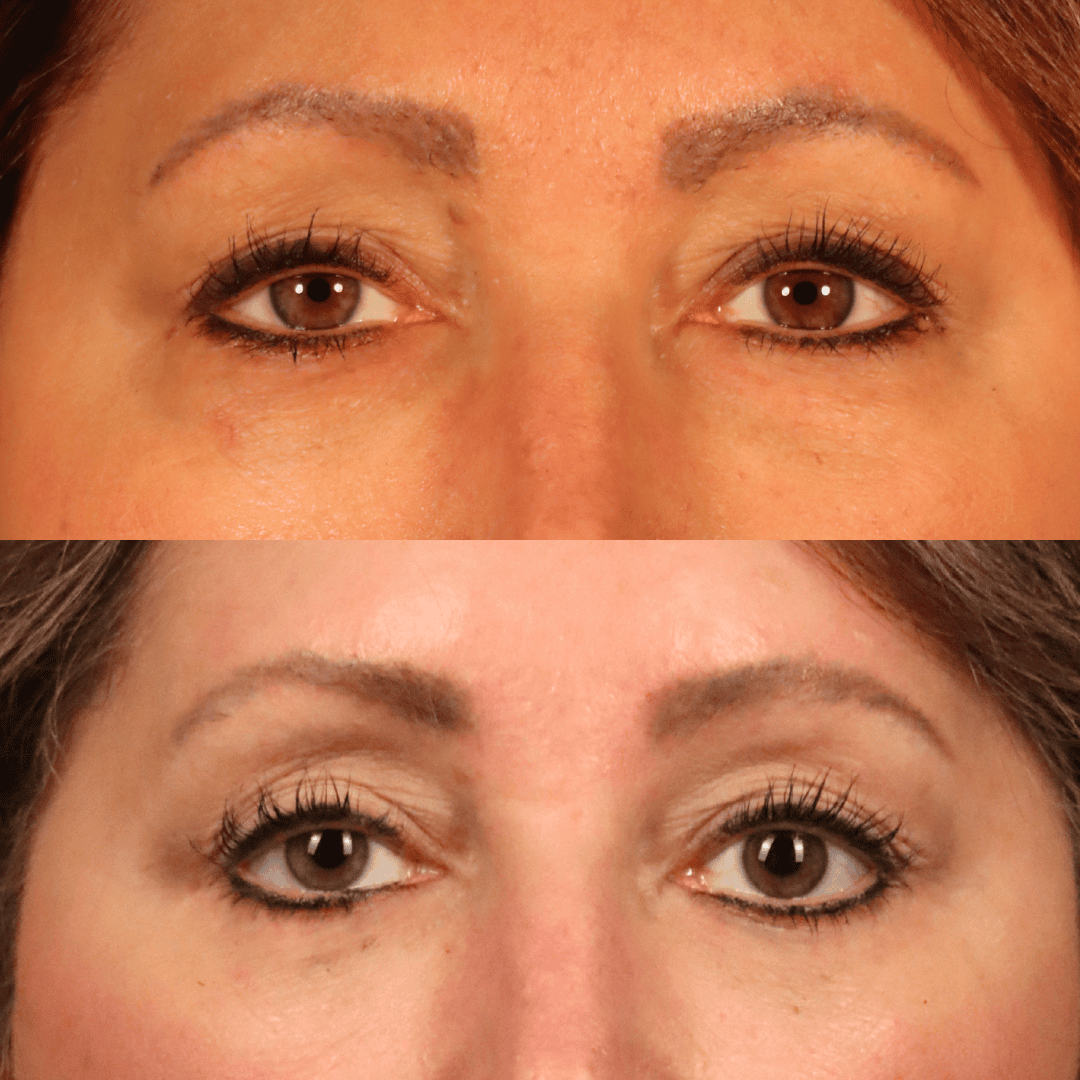
AGE 65 | FOLLOW-UP 8 MONTHS
She came to me reporting that she did not look the way she felt. Her eyes looked tired and her neck felt heavy. The challenge was that she was exceptionally slender, with substantial skin and muscle descent but very little fat available either to remove from the neck or harvest for transfer.
|
Preoperative assessment |
Diagnostic overlay |
Frontal result at 8 months |
|---|
She had volume loss through the temples, brow, tear troughs, cheeks, perioral region, prejowl sulci and chin, but I was able to harvest only 6 cc of usable fat. I used it selectively: 1 cc to the chin, 1 cc to each prejowl sulcus and 1.5 cc to each tear trough. I deliberately did not graft the brow during the brow lift because the newly elevated orbital tissues would have provided less reliable containment for precise fat placement.
We discussed forehead reduction and lip lift, but she did not want either procedure. Those boundaries became part of the composition. I also preserved upper-eyelid fat during a conservative blepharoplasty because opening the eyes without hollowing them was more important than maximizing skin removal.
Three months before surgery, she underwent awake ablative CO2 resurfacing of the face and neck at Tone Medical Aesthetics. That treated photoaging, texture and cheek scars that surgery itself could not correct.
At eight months, the most striking improvement is the relationship between her eyes, cheek, jawline and neck. Her neck has been dramatically elevated despite almost no fat removal. The eyes are open, feminine and elegant without appearing hollow or surgically enlarged. Her face remains appropriately slender rather than artificially filled.
The most sophisticated operation is not the one in which the surgeon does the most. It is the one in which every intervention has a purpose, normal anatomy is preserved when it does not need to be removed, and identifiable imperfections are sometimes deliberately left alone because treating them would not improve the composition.
|
Eye result detail |
Three-quarter smiling result |
|---|---|
|
Profile comparison |
Treating surgery as the entire rejuvenation experience leaves too much of the final result to chance. That is why Tone Medical Aesthetics was purpose-built for my facelift patients.
Tone is not a med spa referral or an optional amenity attached to surgery. It is my integrated aesthetics team, working under a unified philosophy toward the same result. I communicate with the team daily so that surgical planning, skin treatment and long-term maintenance remain coordinated rather than fragmented.
Before surgery, Tone evaluates skin health and may recommend individualized medical-grade skincare, facials, microneedling or laser resurfacing to improve the surface upon which I will operate.
Every facelift patient receives a coordinated series of recovery services through Tone as part of the surgical experience. These visits create structure during recovery and give patients continued access to a team that understands both the operation and the intended result.
| Typical timing | Included service | Role in the experience |
|---|---|---|
| 1–2 days before surgery or 24+ hours afterward | Hydration IV drip | Supports perioperative hydration and gives the patient a dedicated recovery touchpoint with the Tone team. |
| 3–7 days after surgery | Low-energy Ultra laser bruise treatment | A targeted treatment used to support the resolution of postoperative bruising. |
| 2 weeks after surgery | Lymphatic drainage | A very gentle massage technique intended to help reduce postoperative swelling. |
| 4–6 weeks after surgery | Red light therapy | A later recovery treatment used to support the healing process. |
Timing is individualized and may be adjusted by the surgical and Tone teams based on the patient’s recovery.
Once healing is complete, Tone becomes the patient’s long-term home for protecting skin quality and preserving the harmony of the result. Every facelift patient receives a complimentary one-year Tone membership—including a birthday hydrofacial and four infrared sauna sessions—and an individualized maintenance strategy designed around her surgery, skin and pattern of aging.
An elite facelift requires an exceptional operation. A world-class result requires an ecosystem built to prepare it, support it and care for it over time.
At Okland Facial Plastic Surgery, surgery and aesthetic care are not separate experiences. They are one continuum, organized around one result: yours.
A patient can look presentable long before her face has finished healing. The recovery timeline below describes the extended deep plane face and neck lift I perform.
A facelift recovery runs on two clocks. The first determines when you can comfortably be seen. The second determines when the tissues have finished softening, settling and revealing the result. Those clocks are not the same.
I visit with you at the surgery center on your surgery day. We spend a good half hour discussing goals and questions while I perform my markings and part your hair around incisions so I do not have to negotiate with or cut hair during surgery. Following surgery, you leave with a secure headwrap and detailed instructions. A responsible adult must take you home and remain with you at least overnight. Tightness, pressure and heaviness are generally more prominent than sharp pain.
Swelling is most pronounced. The face may look wider—occasionally “alien”—and the neck broader than it did before surgery. This is not the moment to evaluate the jawline or neck contour. The brow-lift headache is usually the most uncomfortable element of this period, although neck tightness and tenderness around the ears are not uncommon. A recovery IV at Tone within the first 24–48 hours is recommended.
I ask every patient to return to my office the morning after surgery, including on a weekend when necessary. I remove the headwrap, inspect the incisions, give you a pep talk, and teach wound care and re-wrapping. I do not routinely use neck drains. Instead, I use a tight headwrap for the first 24 hours, followed by an Ace wrap 24/7 for the first week except while showering or performing wound care.
Bruising begins to resolve and the broadest swelling recedes. The architecture of the result starts to emerge, but the face remains firm and unevenly swollen. Patients generally return to Tone for treatment of darker bruises with low-energy Ultra laser. Sutures are removed at approximately one week.
Many patients look increasingly presentable, although incisions remain visible at close range and swelling often settles in the lower face. After suture removal, head wrapping decreases from 24/7 to nighttime only for six weeks. I recommend the first lymphatic drainage treatment at the end of week two.
Most patients have resumed ordinary social life. The face looks more natural in motion, but cheeks and neck may remain firm, scars may be pink and swelling can fluctuate after activity, travel, alcohol or a salty meal. Continue wrapping the head and neck at night.
Around week three, enough swelling may have fallen that the contour improvements are visible while residual swelling temporarily smooths many wrinkles. This is not the final result. The contours continue to improve, but as swelling resolves, some wrinkles return—softer, but not completely gone.
The cheek, jawline and neck soften into one another. Temporary asymmetries diminish and photographs become more representative. Fat-transfer swelling has substantially resolved. Residual firmness and tightness continue to fade, incisions quiet, sensation gradually normalizes and Endotine devices begin dissolving around six months.
The tissues reach surgical maturity. The final subtleties of the cheek, jawline and neck become apparent. A result can look excellent long before this point, but it is not finished evolving.
Tone’s included recovery treatments are sequenced throughout this process to support hydration, bruising, lymphatic drainage and later healing. During the later healing window, I may begin maintenance treatments such as biostimulators, gentle lasers and/or microneedling when appropriate.
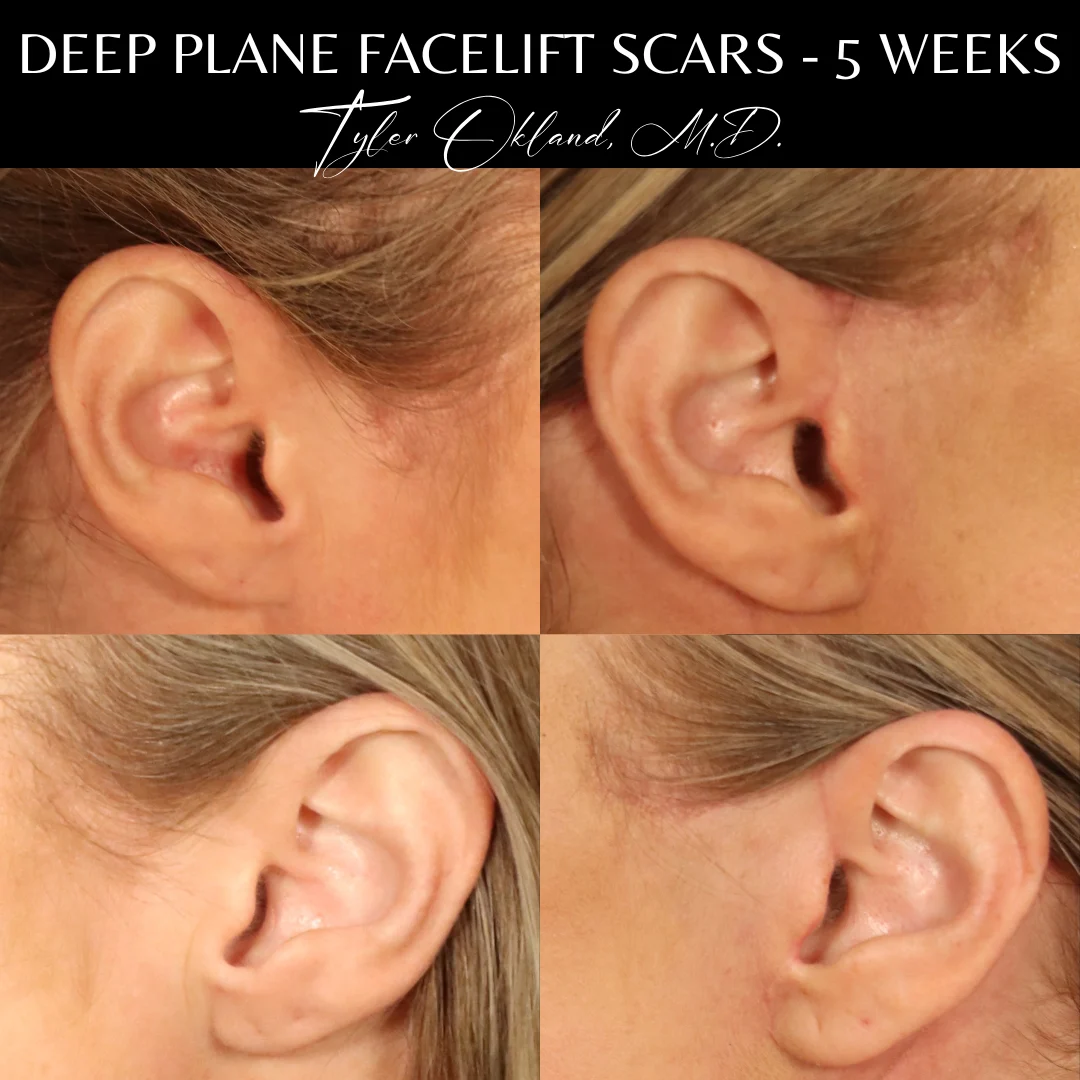
A face and neck lift is not scarless. My continuous incision begins along the temporal hairline, follows the natural contours around the ear, continues behind the ear and terminates within the posterior hairline. A short incision beneath the chin provides access to the central neck.
The scar succeeds or fails through its design, the way tissue is handled and the tension placed upon closure. In an extended deep plane facelift, the repositioned SMAS and platysma carry the correction. The skin is redraped and closed without being asked to suspend the face.
The skin should finish the operation. It should not have to hold it up.
When excessive force is transferred to skin, the evidence can become visible: widened scars, a displaced sideburn, tragal distortion or a pulled “pixie” earlobe. These are not inevitable signs of facelift surgery.
When evaluating a surgeon, ask to see mature scars from both sides with the hair pulled completely away from the ears. A beautifully rejuvenated face should not depend on strategically arranged hair to conceal how it was created.
|
Facelift scars at approximately 5 weeks |
Ear/scar appearance at approximately 18 months |
|---|
Two to three weeks may be adequate for ordinary social reentry. It is not the interval I would choose before a wedding, reunion or filmed appearance. For an event at which every photograph matters, think in months rather than weeks. I prefer at least two months, with more time whenever possible.
Recovery is finite. The result should remain with you for years.
Confidence should come from understanding the operation—not pretending it is minor.
An extended deep plane face and neck lift is a substantial elective operation. Potential complications include bleeding or hematoma, infection, fluid collection, poor wound healing or skin loss, unfavorable scarring, prolonged swelling, asymmetry, numbness or other sensory change, hair loss near incisions, anesthesia-related complications and dissatisfaction requiring revision. Facial nerve weakness can occur and may be temporary or, rarely, permanent.
The facial nerve deserves particular respect in deep plane surgery because its branches traverse the anatomy beneath the SMAS. The purpose of operating in a precise anatomical plane is not to make risk disappear. It is to make the operation controlled and reproducible while protecting the structures that matter.
Risk is influenced by the operation, the surgeon, the patient, her history and the quality of perioperative care. Nicotine exposure, uncontrolled blood pressure, medications or supplements that increase bleeding, prior surgery, fibrosis from previous treatments, medical illness and poor adherence can change the profile substantially.
My responsibility is to identify those variables, modify what can be modified and tell a patient when the safest decision is to delay or decline surgery. Your responsibility is to disclose your complete history and follow the preparation and recovery plan exactly.
The purpose of informed consent is not to frighten a patient or bury risk inside paperwork. It is to make certain that the choice remains genuinely informed.
A facelift does not expire, but it does change as you age.
A facelift establishes a new anatomical starting point. If the result makes a 60-year-old appear closer to 50, she does not suddenly lose that difference at a predetermined anniversary. At 70, she may look closer to 60. She continues to age—just from a more favorable position.
A 2026 study examining 30 years of deep plane facelift surgery evaluated patients who eventually returned for another facelift. The average interval between the first deep plane facelift and the second was 10.9 years. Patients who had their first facelift at age 53 or younger returned after an average of 12.4 years; those older than 53 returned after 9.3 years. Some returned decades later.
The study included only patients who chose another facelift. It therefore tells us when revision patients tended to return—not when every original operation stopped providing benefit.
Approximately eleven years is a reasonable evidence-based expectation before revision among patients who ultimately choose one. Many remain satisfied considerably longer.
A patient ten years after surgery will not look exactly as she did at one year. She should remain meaningfully ahead of where she would have been without surgery. Recurrent aging is not the same as reversal of the operation.
Longevity is influenced by the original technique, age, genetics, skin elasticity, hormonal change, sun damage, nicotine, facial fat and skeletal atrophy, weight fluctuation and maintenance afterward. The durability of the operation is determined by where the correction was placed and what was asked to support it—not by how tight the face looked during the first month.
Tone cannot stop aging or make a facelift permanent. It can help lengthen the runway of the result by protecting skin quality, collagen, pigmentation and volume through a plan coordinated with the anatomy beneath it.
Source: Levin M, Frankel AS. “Thirty Years of Deep Plane Facelifts: Characterizing Outcomes and Longevity.” Facial Plastic Surgery & Aesthetic Medicine. Published online February 26, 2026. DOI: 10.1177/26893614261422044.
No, you don’t. No one needs a facelift or any other cosmetic procedure.
Cosmetic surgery is elective, it’s discretionary. It should be chosen, not prescribed.
The relevant question is whether the changes you see bother you enough that correcting them is worth the recovery, expense, aftercare and risk. If the answer is yes, you do not need to wait to be in a state of aged disrepair. Modern facial rejuvenation is powerful—and natural—enough to benefit patients well before they look conspicuously old. This is why facelifting has continued to trend younger.
An extended deep plane facelift returns tissues toward positions they previously occupied. If the cheek, jawline and neck have fallen only slightly, the anatomical distance available to recover is also small. Surgery can still create a beautiful result, but the delta will be more limited.
I cannot move tissue beyond where it once belonged merely to manufacture a more dramatic transformation. That would begin changing the patient rather than restoring her. This creates tension and distortion. The most dramatic results therefore tend to occur in older patients: more tissue has descended, so there is more distance available to recover.
Substantial weight loss can produce facial deflation, skin redundancy and descent disproportionate to chronological age. A patient in her thirties may therefore have the anatomy of a much older candidate. In that setting, an extended deep plane facelift may be entirely appropriate once major weight loss is complete and weight is stable.
A good candidate has not reached a required birthday. Four things are true:
The change matters enough. She—not her spouse, friends, children or surgeon—is sufficiently bothered by what she sees.
The anatomy supports meaningful correction. There is enough descent, neck laxity, atrophy or upper-face aging to improve without distortion.
She accepts the undertaking. She understands the anesthesia, incisions, recovery, expense, aftercare and risks and believes the result justifies them.
Her health and circumstances permit it. Weight is stable, nicotine is absent, medical risk is acceptable and recovery can receive the time it deserves.
My role is not to declare that a patient “needs” surgery. It is to determine what changed, what can be restored and what operation the available improvement requires. I may conclude that the delta is too small and recommend continued care through Tone. I may also conclude that a patient is an excellent candidate even if she does not look old to anyone else.
You do not need to prove that you look sufficiently aged. You need to understand what surgery can change, what it will require of you, and decide whether the exchange is worth it.
AGE 45 | FOLLOW-UP 18 MONTHS AFTER FACIAL REJUVENATION; 2 MONTHS AFTER UPPER BLEPHAROPLASTY
She felt that her eyes had begun to look tired and that she had gradually “lost her spark.” She was also beginning to notice heaviness through the lower central face despite otherwise relatively early facial aging.
|
Preoperative assessment |
Diagnostic overlay |
Frontal result |
|---|
She had significant brow ptosis with lateral eye hooding, early midface flattening, subtle neck laxity and early volume loss through the tear troughs, cheeks, upper eyelid A-frame, temples and prejowl region. Her upper lip had also lengthened. There was essentially no facial volume excess to remove.
I was able to harvest only approximately 6 cc of usable fat. I therefore prioritized 0.6 cc to each prejowl sulcus, 1.5 cc to each tear trough/cheek region, and 1.5 cc total to the upper and lower lips. Although the chin, temples and upper eyelids could also have benefited, there simply was not enough high-quality donor fat available.
Her brow and outer eye position are elevated without appearing surprised. The midface has regained curvature and support. The lower face and jawline are cleaner without appearing pulled. Her upper lip is shorter and better proportioned, while limited fat restoration softened early skeletonization without making the face look overfilled or front-heavy.
The photographs are unusual because they were taken 18 months after the primary facial rejuvenation but only approximately two months after a secondary upper blepharoplasty. The lateral upper-eyelid scars are therefore still pink and early in their healing. Even with the eyelids still healing, the overall transformation is striking.
Most importantly, she does not look tight.
That distinction matters particularly in younger facial rejuvenation patients. The goal is not to make someone look surgically altered or dramatically different. It is to restore the shapes, transitions and proportions associated with a younger version of the same face.
|
Three-quarter result |
Profile result |
|---|---|
|
Smiling profile/three-quarter result |
Neck flexion result |
The recommendation comes first. The quote follows it.
Facial rejuvenation in my practice is not organized into standardized packages. I evaluate the entire face, determine the composition I believe will produce the strongest result and provide a written quote for that plan.
For most patients, the structural foundation includes a brow lift, extended deep plane face and neck lift, and individualized fat transfer. Blepharoplasty, lip lift, CO2 resurfacing and other refinements are added only when they solve a specific problem.
Current starting prices are published on my website and include anticipated surgical, anesthesia and facility expenses. Fat transfer and the included recovery treatments through Tone Medical Aesthetics are included in every facelift experience.
Approximately half of my patients travel from out of state. My team provides the medical itinerary: when the patient must arrive, how long she must remain in Denver, when postoperative appointments and Tone treatments occur and when she may return home.
Patients arrange their own transportation, accommodations and required adult caregiver. Once the patient returns home, follow-up continues through the appropriate combination of virtual appointments and scheduled in-person visits.
For our postoperative patients who have traveled out of state, updates often come in the form of progress photos.
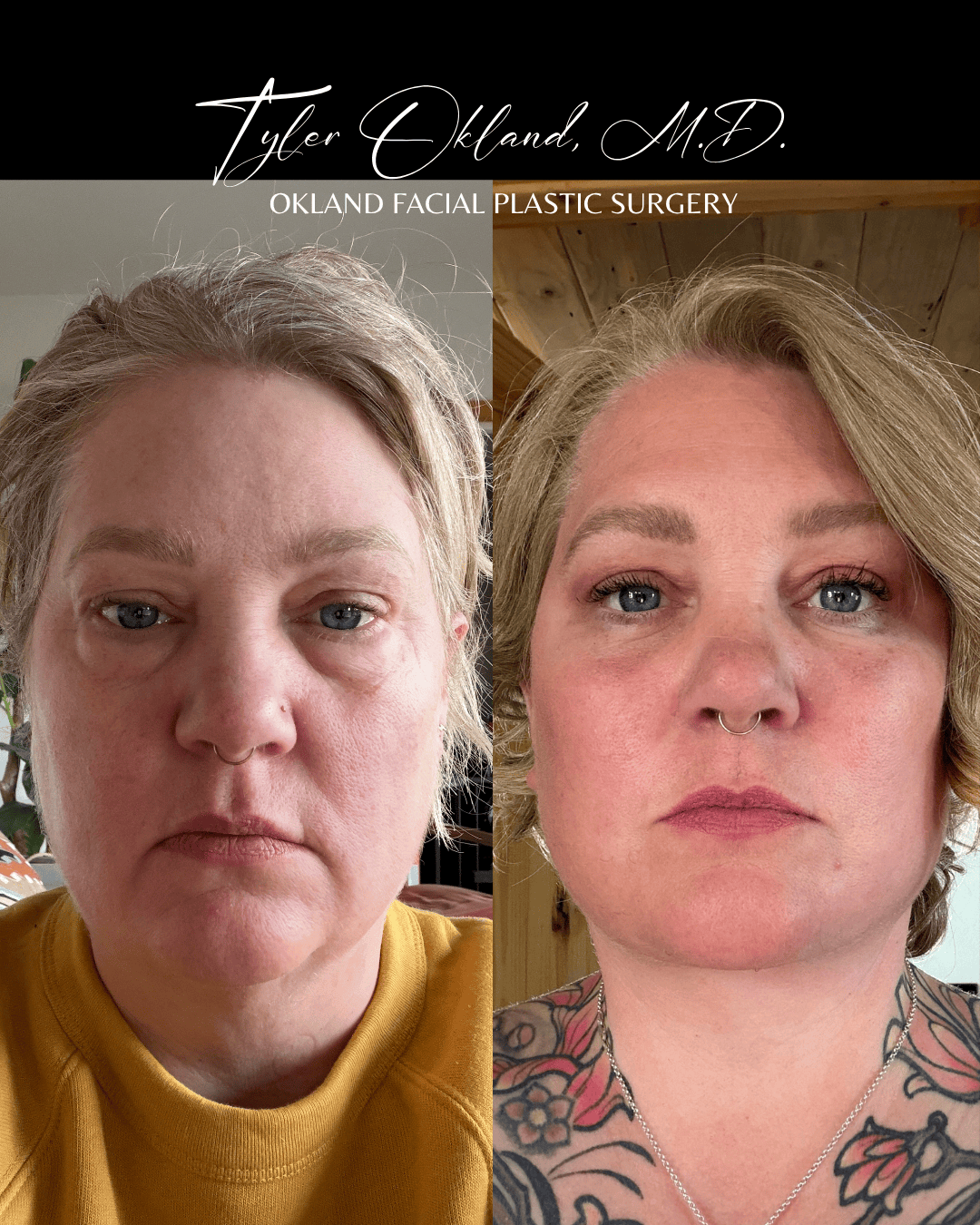
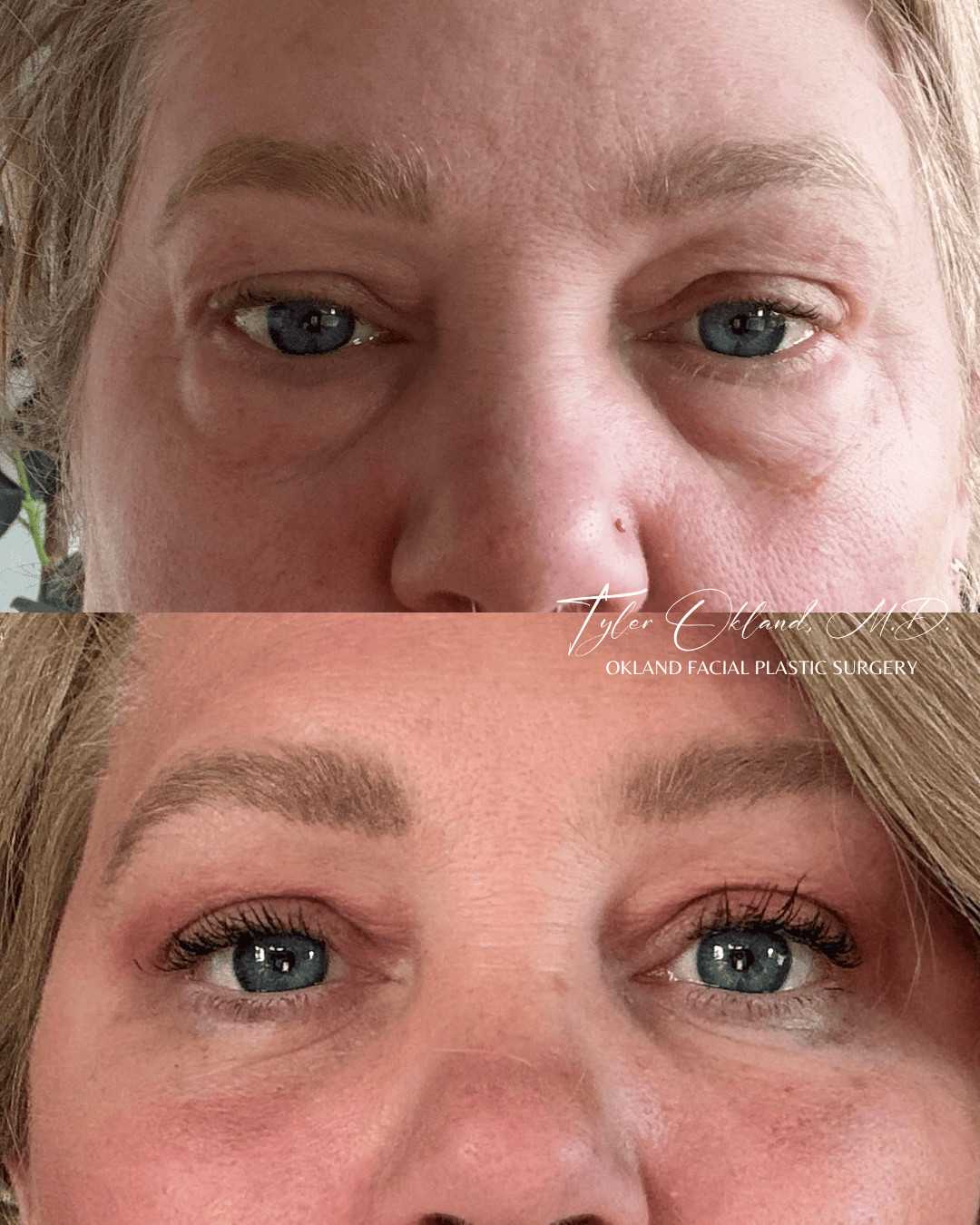
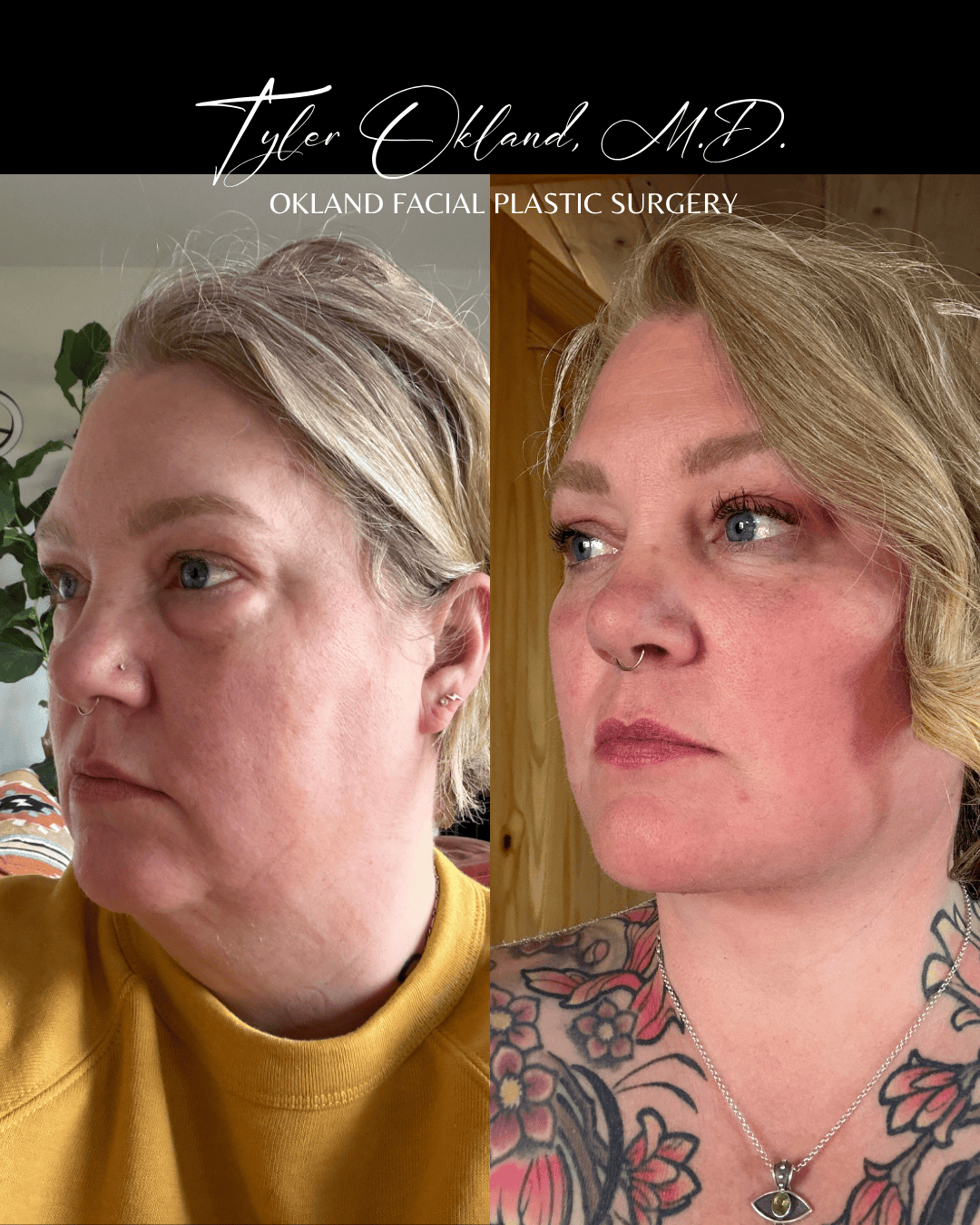
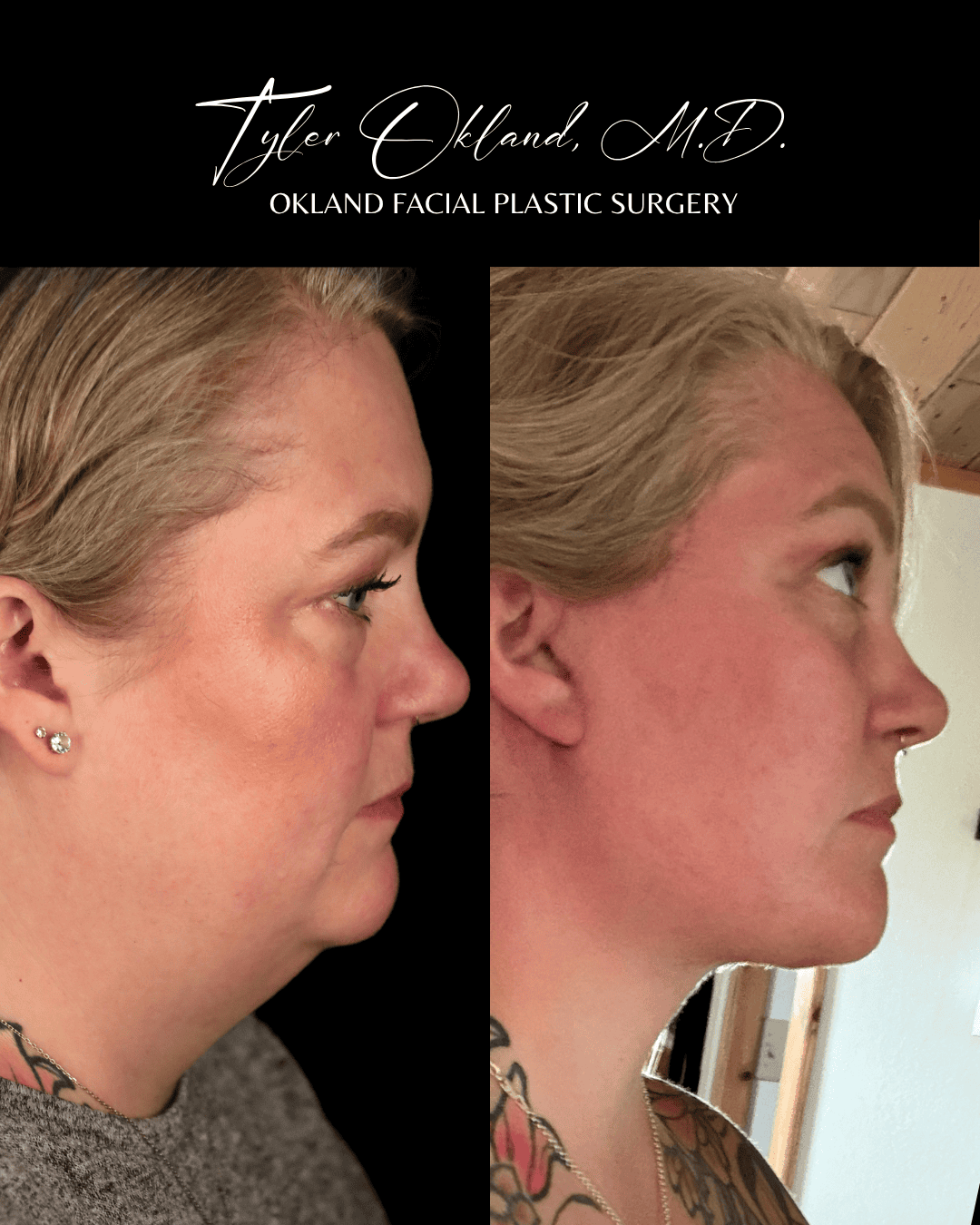
Three-month progress update after extended deep plane facelift, deep neck lift, lower blepharoplasty, buccal fat reduction and fat transfer.
Scroll to view progress photos
Before reserving surgery, every patient should understand the recommended operation, complete anticipated cost, required time in Denver, expected recovery and postoperative care plan.
It is a face and neck lift performed beneath the SMAS and platysma through an extended field that releases the key retaining ligaments constraining the cheek, jowl, jawline and neck. The tissues are repositioned as a connected structural unit with less dependence on skin tension.
No. “Deep plane” describes a surgical plane, but not how far the operation extends or which ligaments are released. “Extended” should indicate a longer dissection field and more comprehensive release through the face and neck. Ask the surgeon to define the anatomy rather than relying on the label. A standard deep plane facelift is probably one of the most variable and least transparent plastic surgery procedures of the modern day because the meaningful difference depends on how far a surgeon operates in a plane you cannot see outside the operating room.
Many patients are socially presentable within two to three weeks, but the face continues to soften and mature for six to twelve months. Important photographed events should be planned in months, not weeks; I prefer at least two months whenever possible.
Most patients describe tightness, pressure, heaviness and swelling more than sharp pain. A concurrent brow lift generally involves a headache for 24–48 hours after surgery. Discomfort varies with the extent of the operation and the individual. Medication instructions, warning signs and direct postoperative guidance are reviewed before surgery.
The objective is restoration, not reinvention. Deep plane lifting returns tissues toward positions they previously occupied. Proper vectors, coherent treatment of the full face and restraint in fat transfer should preserve identity while removing the visual distractions of aging.
The brow creates the upper destination for tissues elevated from the neck and face. Leaving it descended can create bunching or force the lower lift to be weakened. Very few true extended deep plane candidates have meaningful face and neck laxity without upper-face descent.
Lifting treats gravity; fat transfer treats atrophy. Every face develops selective volume loss even when it does not look conspicuously hollow. I evaluate the entire face and place only the volume needed to restore structure and smooth transitions.
Usually, yes. These treatments do not automatically prevent surgery, but they can alter the diagnosis and surgical planes. A complete treatment history allows me to decide whether filler should be dissolved, whether timing should change and how fibrosis or tissue loss should influence the operation.
A facelift does not expire. Among patients who eventually returned for revision in a 30-year deep plane study published in 2026, the average interval was 10.9 years. Many patients remain satisfied longer and should continue to look better than they would have without surgery.
The investment depends on the individualized composition. Current starting prices—including anticipated surgery, anesthesia and facility expenses—are published on the dedicated pricing page. Each patient receives a written quote after consultation.
Yes. Approximately half of my patients travel from out of state. My team defines the required medical timeline and follow-up schedule; patients arrange transportation, accommodations and an adult caregiver.
The goal of modern facial rejuvenation is not to erase every sign of time or impose a standardized version of youth. It is to understand what changed, restore the anatomy that can be restored and leave untouched what still belongs beautifully to the patient.
That demands more than a named technique. It requires complete release, precise vectors, control of the deep neck, disciplined volume restoration, coherent treatment of the connected face and a team capable of caring for the result beyond the operating room.
I have built my practice around that standard. I do not offer every type of facelift. I perform the operation I would be proud to place in my gallery and comprehensive facial rejuvenation I would be proud to place my name on.
If that philosophy aligns with what you want for your face, I would be honored to meet you.